

Search engine optimization normally works on a long timeline. You improve a website, publish useful content, fix technical problems, build authority, and wait for search engines to crawl, evaluate, and rank those changes.
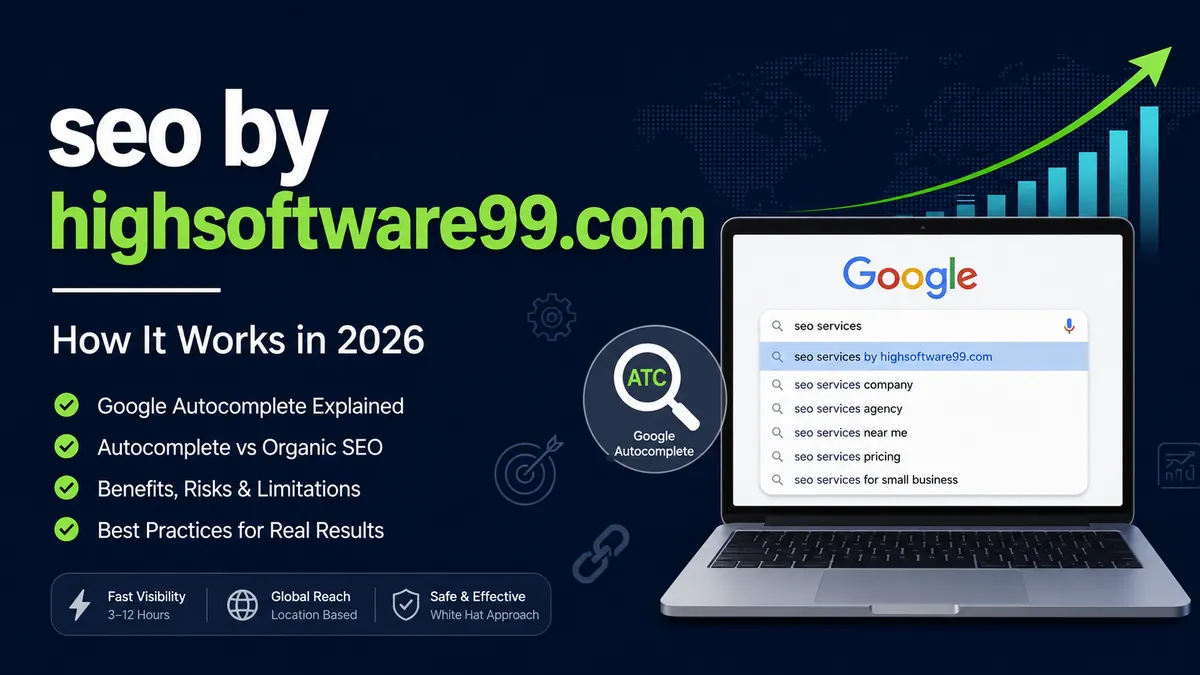
That makes claims of search visibility within hours naturally attention-grabbing. seo by highsoftware99.com has attracted interest largely because HighSoftware99.com promotes Google Autocomplete, or ATC, visibility alongside broader digital marketing and SEO services. Its website says keywords can be boosted through autocomplete within 3–12 hours.
Quick answer: seo by highsoftware99.com is associated primarily with Google Autocomplete visibility, where a brand or keyword phrase may appear as a prediction while someone types a search. That should not be confused with achieving a top organic Google ranking. Autocomplete predictions and conventional search rankings are different search experiences governed by different systems.
Understanding that distinction is the key to evaluating the service fairly.
What Is seo by highsoftware99.com?
The phrase seo by highsoftware99.com generally refers to search visibility services associated with HighSoftware99.com.
The company’s current website prominently describes its offering as “Google Auto Complete / ATC Services” and presents examples involving searches for “seo” in the United States and “seo service” in India. It also lists broader digital marketing areas such as SEO/SEM, content creation, brand strategy, social media management, and web design.
This has created some confusion online because third-party pages describe the brand in different ways. Some characterize it as a complete SEO framework involving technical optimization, content, internal links, and authority building. Others focus specifically on autocomplete manipulation or promotion.
The safest interpretation is therefore based on what can currently be verified directly: HighSoftware99.com’s most distinctive advertised feature is rapid Google Autocomplete visibility.
That is very different from saying a website can rank number one organically within a few hours.
How seo by highsoftware99.com Relates to Google Autocomplete
To understand the concept, first consider a normal Google search.
Suppose you start typing:
best running shoes
Before you finish, Google may display several predicted queries below the search box.
Those suggestions are Google Autocomplete.
Google explains that its automated systems generate predictions partly from real searches. Other factors can include:
- the language of the query;
- the searcher’s location;
- trending interest;
- previous searches and personalization;
- common queries related to what someone has started typing.
This means autocomplete exists before a person even reaches the conventional search results page.
Why autocomplete visibility can matter
Search suggestions can influence what people decide to search.
Imagine someone types:
best accounting software
If a particular brand-related phrase appears as a prediction, the user may select it rather than completing the original query manually.
That creates a potential discovery and branding opportunity.
It is why autocomplete-focused strategies are sometimes described as search-bar visibility, autosuggest marketing, brand search optimization, or autocomplete SEO.
The critical limitation is that autocomplete predictions themselves are not rankings.
Google explicitly describes predictions as a feature designed to help users complete searches faster.
seo by highsoftware99.com vs Traditional Organic SEO
This is where many explanations of the topic become misleading.
Autocomplete visibility and organic rankings can both expose a brand to searchers, but they operate at different stages.
| Area | Autocomplete Visibility | Traditional Organic SEO |
|---|---|---|
| Appears | While typing a query | After submitting the query |
| Main objective | Query/brand discovery | Rank webpages in results |
| Typical focus | Search predictions | Content, crawling, indexing, relevance and authority |
| User action | Select a suggested query | Click a search result |
| Guaranteed ranking? | No | No |
| Long-term website foundation | Limited by itself | Central objective |
A brand appearing in autocomplete does not automatically mean its website ranks first for the corresponding keyword.
For example, a prediction could encourage someone to search for a particular company. Google would then generate a results page for that query, where websites still need to compete for organic visibility.
This distinction is essential when interpreting claims surrounding seo by highsoftware99.com.
Does seo by highsoftware99.com Provide Instant Rankings?
No credible interpretation of “instant appear” should be treated as a guarantee of instant organic Google rankings.
Google’s own SEO Starter Guide explicitly states that there are no secrets that automatically rank a website first. Google also says that some SEO changes may become visible within hours, while others can take several months.
There are actually several separate events that website owners sometimes bundle together as “ranking”:
- Discovery — Google discovers a URL.
- Crawling — Google’s crawler accesses it.
- Indexing — Google processes the page and may add it to its index.
- Ranking — Google’s systems determine when and where the page should appear for relevant queries.
- Autocomplete visibility — a query appears as a prediction before a search is submitted.
These events are not interchangeable.
A page could be indexed quickly without ranking prominently. Likewise, a phrase could appear in autocomplete while the associated website remains far below the first organic result.
Quick Takeaway
Fast appearance does not necessarily mean fast ranking.
When evaluating seo by highsoftware99.com—or any SEO service—always ask exactly where something is supposed to “appear”: autocomplete predictions, Google’s index, organic results, local results, or another search feature.
Why Google Autocomplete Changes Between Users
Another important limitation is geography and personalization.
HighSoftware99.com’s website itself demonstrates different autocomplete examples for the United States and India.
That makes sense because Google says autocomplete can consider location, language, trends, and previous searches.
Consequently, seeing a prediction on one computer does not prove everyone sees it.
Two people can type the same letters and receive different suggestions because they are:
- in different countries;
- using different languages;
- searching at different times;
- signed into accounts with different histories;
- affected by changing trends.
This makes independent testing particularly important.
If someone claims a phrase is appearing in autocomplete, test it across appropriate locations, devices, clean browser sessions, and relevant target markets rather than relying on a single screenshot.
What Traditional SEO Still Requires
Autocomplete visibility does not replace the fundamentals needed to build organic search traffic.
Google defines SEO as helping search engines understand content and helping users find a site through search. Its Search Essentials emphasize technical accessibility, compliance with spam policies, and helpful, reliable, people-first content.
For most websites, that translates into several interconnected areas.
Technical SEO and crawlability
Search engines need reliable access to important pages.
Technical work commonly involves:
- crawlable internal links;
- sensible URL structures;
- correct canonicalization;
- indexation management;
- XML sitemaps where appropriate;
- server reliability;
- mobile usability;
- performance optimization;
- eliminating accidental crawling or indexing barriers.
Technical optimization cannot make weak content authoritative, but technical problems can prevent strong content from performing properly.
Search intent and content quality
A page needs to answer the reason behind the query.
Someone searching “how to calculate mortgage interest” needs a fundamentally different page from someone searching “mortgage broker near me.”
Trying to force both intentions onto one generic page usually produces a poor experience.
Modern content strategy therefore starts with the user’s problem and builds the page around solving it clearly.
Google’s Search Essentials specifically recommends creating helpful, reliable, people-first content and using terminology people actually use to find that information.
On-page optimization
On-page SEO helps establish what a page is about.
Useful elements include:
- descriptive page titles;
- one clear main heading;
- logical H2 and H3 sections;
- concise introductions;
- descriptive anchor text;
- relevant image alt text;
- useful internal links;
- clear topical coverage.
Keywords remain useful, but repetition is not the goal.
A page about technical SEO will naturally discuss concepts such as crawling, indexing, canonical URLs, site architecture, redirects, sitemaps, and search engines because those concepts belong to the topic.
That is semantic relevance—not keyword stuffing.
Internal linking and site architecture
Internal links connect related information and help users navigate a website.
They also establish relationships between pages.
For example, an extensive SEO website might have a broad SEO Guide linked to specialized resources covering:
- keyword research;
- technical SEO;
- on-page optimization;
- link building;
- local SEO;
- content strategy.
The result is a logical topic structure rather than hundreds of isolated articles.
Authority and external links
Links from other websites can help search engines discover pages and understand their broader context, but link quality matters far more than simply collecting enormous numbers of backlinks.
Editorial mentions from relevant, legitimate websites have a fundamentally different value and risk profile from automated spam links.
A sustainable strategy focuses on creating something worth referencing: original research, tools, expert resources, useful data, distinctive reporting, or genuinely strong informational content.
Can Autocomplete Replace Organic SEO?
No.
Autocomplete visibility may complement a broader search strategy, particularly for branded discovery, but it cannot perform the jobs handled by technical SEO, useful content, internal architecture, reputation, and organic search optimization.
Consider a company that successfully gets its brand-associated query displayed in autocomplete.
That creates an opportunity.
But what happens after someone selects the prediction?
The searcher still reaches a search results page. At that point, the company’s website, reviews, social profiles, competitors, third-party articles, and other results can shape the user’s impression.
A weak website does not suddenly become useful because the query that leads to it was suggested by Google.
The strongest model is therefore:
Discovery → Search → Useful result → Helpful website → Trust
Autocomplete concerns primarily the beginning of that journey. Traditional SEO affects much more of what follows.
Are There Risks With Autocomplete SEO?
There can be, depending on how visibility is produced.
Google’s spam policies prohibit practices intended to deceive users or manipulate Search systems into featuring content prominently. The policies cover areas such as link spam, doorway abuse, cloaking, scaled content abuse, and other manipulative practices. Violations can result in lower rankings or removal from results.
Google also says autocomplete predictions are generated automatically and subject to policies designed to prevent inappropriate or unhelpful predictions.
That does not mean every attempt at building brand demand is prohibited.
There is an enormous difference between legitimate marketing that causes real people to search for a brand and artificial activity designed specifically to make automated systems believe demand exists when it does not.
Questions worth asking
When examining seo by highsoftware99.com or any autocomplete-focused provider, the useful questions are methodological:
Where does the visibility appear?
Determine whether the promised outcome concerns autocomplete, organic results, indexing, Google Business Profile visibility, or something else.
Is the result location-specific?
A suggestion visible in India may not appear in the United States, United Kingdom, Pakistan, or another target market.
How is demand generated?
Understand whether the method relies on legitimate promotion and genuine searches or artificial signals.
What happens if the campaign stops?
Temporary visibility and durable organic equity are different outcomes.
How is success measured?
Screenshots alone are weak evidence. Search Console data, organic traffic, qualified impressions, conversions, and independently reproducible tests provide much better context.
These questions turn an impressive-looking promise into something measurable.
Google Autocomplete Is Not Google Trends
Autocomplete is also sometimes treated as proof that a term has enormous search volume.
That conclusion is unreliable.
Google explicitly says autocomplete should not be compared directly with Google Trends. Autocomplete is a complex time-saving feature rather than a simple list of the most popular searches.
Therefore, a prediction appearing in the search box does not tell you its exact monthly search volume.
For SEO analysis, treat different datasets according to what they actually measure:
| Tool or Feature | Best Used For |
| Google Autocomplete | Discovering predicted searches |
| Google Trends | Comparing interest over time |
| Google Search Console | Measuring your site’s actual Google Search performance |
| Analytics platform | Measuring website visits and behavior |
| SEO keyword tools | Estimating keyword demand and competition |
Combining these sources creates a much more reliable picture than using autocomplete alone.
What Safe, Sustainable SEO Looks Like in 2026
The discussion around seo by highsoftware99.com reflects a broader challenge: businesses naturally want SEO results faster.
Speed is useful, but sustainable SEO requires building assets that continue producing value.
1. Make important pages accessible
Check that search engines can discover, crawl, render, and potentially index your valuable pages.
Do not assume publishing automatically means ranking.
2. Map each page to a clear search intent
Give every important URL a purpose.
Avoid creating numerous near-identical pages simply to target tiny keyword variations. Google’s spam policies specifically identify doorway abuse and scaled low-value content as problematic practices.
3. Publish genuinely useful information
Answer the question completely.
Original examples, firsthand observations, calculations, screenshots, expert commentary, testing, unique datasets, and practical experience can make content more useful than pages that merely summarize existing search results.
This has become particularly important as generative AI makes generic content extremely cheap to produce.
Google’s guidance says generative AI can help with research and structure, but generating large numbers of pages without adding user value may violate its scaled content abuse policy.
4. Build topical relationships
Connect related pages through sensible internal links.
A clear information architecture helps users move from broad explanations to more specific answers without repeatedly returning to Google.
5. Earn genuine authority
Create resources that other people have a reason to mention.
Strong backlinks are often a consequence of useful assets, relationships, expertise, original information, digital PR, and brand reputation—not simply link volume.
6. Measure outcomes in Search Console
Monitor actual impressions, clicks, queries, pages, and search visibility.
Google recommends Search Console as a primary resource for understanding website performance in Search.
This is particularly valuable when evaluating a new strategy because you can compare claimed visibility with measurable organic performance.
7. Give changes enough time
Not every improvement produces immediate movement.
Google says SEO changes can take anywhere from hours to several months to be reflected.
Evaluate meaningful trends rather than reacting to every daily ranking fluctuation.
How to Evaluate seo by highsoftware99.com Objectively
The best approach is neither automatic trust nor automatic dismissal.
Start with claims that can be independently verified.
HighSoftware99.com currently promotes Google Autocomplete/ATC services and claims rapid autocomplete keyword visibility. That is verifiable from its website.
Google independently confirms that autocomplete predictions exist and explains that they are influenced by real searches alongside factors such as language, location, trends, and search history.
Google does not, however, describe autocomplete appearance as equivalent to an organic ranking. Its SEO documentation makes clear that there is no automatic method for obtaining the number-one organic position.
Those facts give you a useful evaluation framework.
Do not ask only:
“Can they make this phrase appear?”
Also ask:
“What business or SEO outcome does that appearance produce?”
A successful campaign should ultimately connect visibility to meaningful results—relevant searches, qualified visitors, brand discovery, engagement, leads, sales, or another defined objective.
Visibility without measurable downstream value is simply visibility.
Common Misunderstandings About seo by highsoftware99.com
Several misconceptions are worth clearing up.
“Autocomplete means the website ranks number one”
It does not.
Autocomplete predicts queries. Organic search ranks results after a query is submitted.
“If I can see the suggestion, everybody can”
Not necessarily.
Google can adjust predictions according to factors such as location, language, trends, and previous searches.
“Fast indexing means fast ranking”
No.
Discovery, crawling, indexing, and ranking are related but separate processes.
“Autocomplete popularity proves huge search volume”
Not by itself.
Google specifically warns against treating autocomplete like Google Trends.
“Traditional SEO should produce immediate results”
Sometimes individual changes can appear quickly, but significant organic improvement often requires considerably more time. Google says changes can take from a few hours to several months to show their effects.
Is seo by highsoftware99.com Worth Paying Attention To?
It is worth understanding because it highlights an interesting part of search marketing that many website owners overlook: the search journey starts before a person clicks a blue link.
Autocomplete can shape query discovery.
That makes search-bar visibility potentially useful for branding and awareness.
But its value should be judged separately from traditional SEO performance.
A business still needs crawlable pages, technically sound architecture, helpful content, relevant internal links, genuine authority, and a strong user experience if it wants durable organic visibility.
Google’s Search Essentials remain a sensible benchmark: satisfy technical requirements, avoid spam tactics, create reliable people-first content, and make the subject of each page easy for both users and search engines to understand.
Final Thoughts on seo by highsoftware99.com
seo by highsoftware99.com is best understood through the distinction between Google Autocomplete visibility and conventional organic SEO.
HighSoftware99.com currently promotes an ATC service that claims rapid autocomplete exposure, while Google confirms that autocomplete predictions are generated from signals that include real searches, location, language, trends, and personalization.
What autocomplete cannot do by itself is replace the foundations of sustainable search performance.
There is no guaranteed shortcut to the number-one organic position. Google’s own guidance emphasizes useful content, crawlability, clear site organization, relevant language, and compliance with Search Essentials and spam policies.
So when evaluating seo by highsoftware99.com, separate autocomplete appearance, indexing, and organic ranking instead of treating them as the same result. Then measure each against real business outcomes.
That distinction makes it much easier to understand what the strategy can realistically accomplish—and what still requires conventional, long-term SEO work.
