

Few municipalities have to prepare for decades of economic and population change within just a handful of years. That is the challenge facing Boden in northern Sweden, where major industrial investment is reshaping jobs, housing, infrastructure, public services, and the local business environment.
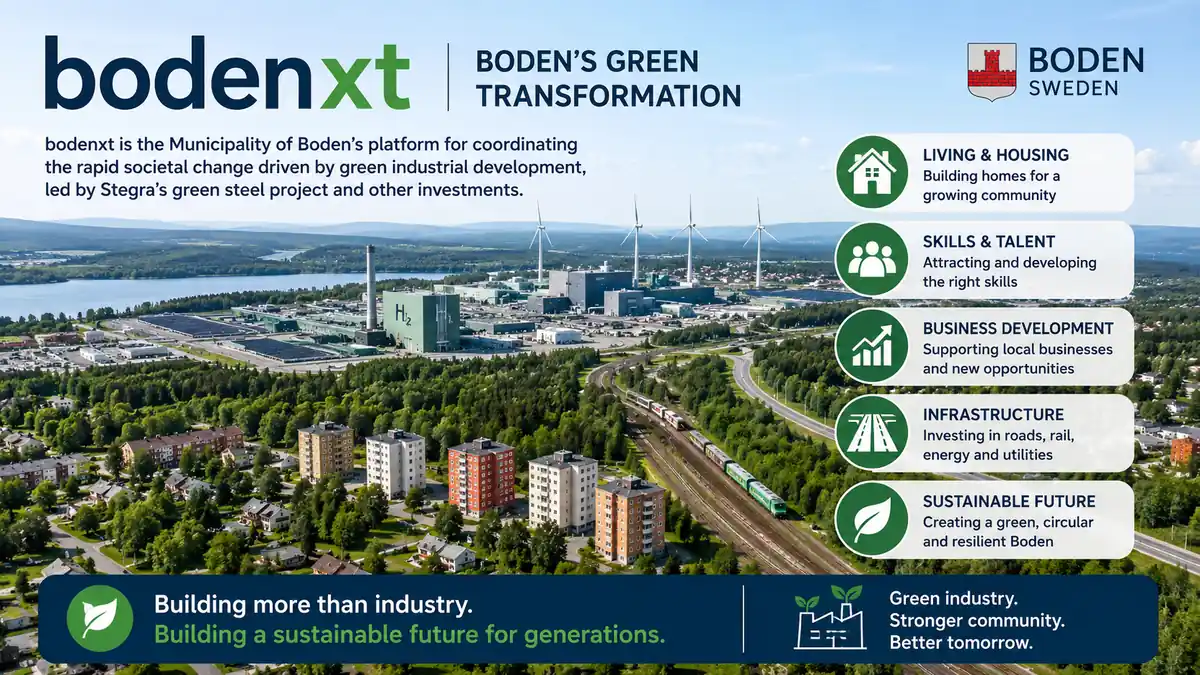
At the center of this transformation is bodenxt, the Municipality of Boden’s development platform for coordinating the community-wide green transition. Rather than being a software product or technology startup, it brings together work involving skills, housing, business development, infrastructure, industry, and sustainable community growth.
Quick answer: bodenxt is the Municipality of Boden’s coordinated platform for managing the rapid societal changes connected with green industrial development in northern Sweden. Stegra’s large-scale green steel project is a major accelerator, while bodenxt addresses the wider needs created by growth, including housing, infrastructure, workforce development, businesses, and public services.
What Is bodenxt?
bodenxt is an organized development platform created to help the Municipality of Boden manage an unusually rapid period of industrial and social transformation.
The municipality describes the coming change as roughly 20 years of development compressed into only a few years. Instead of allowing individual municipal departments to deal separately with housing, roads, workforce needs, business expansion, and other consequences, the bodenxt approach coordinates these areas as parts of the same transformation.
Its development is closely connected to the industrial expansion taking place at Boden Industrial Park, particularly Stegra’s green steel project.
Stegra was previously known as H2 Green Steel. Its establishment created a need to think beyond the industrial plant itself.
A major industrial project needs workers. Workers need homes. Growing neighborhoods need roads, water, schools, services, shops, transportation, and other infrastructure. Companies supplying the new industry also need suitable conditions for expansion.
That interconnected challenge is what bodenxt is designed to address.
Is bodenxt a technology platform?
No—not in the usual sense of a digital software platform.
Some online descriptions have portrayed Bodenxt as an emerging digital technology, AI system, blockchain platform, or productivity solution. Those descriptions should not be confused with the municipality’s documented initiative.
The Municipality of Boden identifies bodenxt as its platform for the broader green transformation of society in Boden. Municipal documents have also described it as a development platform, with work organized across municipal functions and companies.
There is no need to sign up for an app, purchase software, or install a Bodenxt program to understand the initiative.
Why Was bodenxt Created?
The answer starts with the scale and speed of change in northern Sweden.
Boden is located in Norrbotten, a region experiencing substantial investment connected with renewable energy, industrial decarbonization, infrastructure, and new manufacturing.
For Boden, Stegra’s decision to establish a major green steel operation became a particularly important accelerator.
A project of that scale does much more than create jobs inside a factory. It changes demand throughout a community.
New workers require accommodation. Construction requires transportation and utilities. Employers compete for skilled people. Existing companies gain new customers. Public services encounter new demands. Schools, shops, restaurants, healthcare, emergency services, and other parts of daily life can all feel the effects.
Traditional sequential planning—solving one problem before beginning the next—can become too slow under those conditions.
bodenxt therefore represents a more coordinated approach.
The municipality’s own account explains that its organizational model was influenced partly by lessons learned during the pandemic. Instead of relying entirely on traditional administrative boundaries, a project structure was developed that could work across departments and municipal companies.
Quick Takeaway: The central idea behind bodenxt is not simply “build green industry.” It is to make the surrounding community capable of supporting industrial growth without treating housing, infrastructure, skills, and quality of life as separate afterthoughts.
The Main Areas Behind the bodenxt Model
The Municipality of Boden highlights several interconnected areas within its transformation work, especially living and housing, skills supply, business development, and infrastructure above and below ground.
Understanding these areas makes the purpose of bodenxt much clearer.
1. Living and Housing
Industrial expansion cannot become sustainable community growth if workers have nowhere suitable to live.
Housing is therefore one of the most immediate challenges facing Boden.
The issue includes both temporary accommodation for people involved in construction and permanent housing for employees and families who want to settle in the municipality.
Demand is not limited to one type of property.
Different groups may need:
- Small rental apartments
- Family housing
- Temporary contractor accommodation
- Newly constructed homes
- Existing properties
- Housing close to services and transportation
The municipality has warned that housing availability could become a constraint on continued development. In May 2026, it described an acute housing shortage and said several thousand people connected not only with Stegra but also defence, services, retail, public-sector activity, and the wider green industrial value chain may need opportunities to settle in Boden.
This illustrates an important lesson from the bodenxt model: creating employment is only part of successful regional development. People also need a functioning place to build their lives.
2. Skills Supply and Talent Attraction
A modern industrial transformation requires people with many different skills.
Steelmaking and hydrogen production need technical expertise, but the labor-market effect spreads much further.
Demand can extend to engineers, electricians, construction workers, technicians, logistics specialists, hospitality workers, teachers, municipal employees, healthcare professionals, retail staff, and numerous other occupations.
That makes skills supply more than a recruitment issue for one employer.
Boden needs to attract people from elsewhere in Sweden and internationally while also helping local residents connect with emerging employment opportunities.
The municipality has already developed job-matching and relocation activities as part of this broader effort. By December 2025, it reported that more than 600 people had moved to Boden in connection with Stegra’s establishment, while its Relocation Service had supported employees making the transition.
Successful talent attraction therefore depends on several things working together: employment, housing, community integration, education, services, and quality of life.
3. Business Development
Large industrial investments create economic activity far beyond the primary industrial site.
Local companies can gain customers. New suppliers may establish operations. Restaurants and service businesses can experience higher demand. Construction and logistics companies can expand.
The effect is already visible around Boden Industrial Park.
For example, the municipality has documented how local food businesses expanded their activities as construction and workforce demand increased at the industrial site.
The challenge is ensuring that local businesses can participate in this growth rather than watching the largest opportunities pass them by.
That means maintaining dialogue with companies, improving establishment processes, supporting workforce availability, and ensuring that infrastructure and commercial space keep pace.
In 2026, businesses surveyed in Boden continued to identify housing, skills supply, and infrastructure as crucial issues for future growth—showing again how closely the different parts of bodenxt are connected.
4. Infrastructure Above and Below Ground
Industrial transformation requires physical systems capable of supporting it.
Above-ground infrastructure can include roads, rail connections, buildings, public spaces, and transportation networks.
Below ground, the less visible systems can be just as important: water, wastewater, electricity, communications, and other utilities.
Boden Industrial Park illustrates the scale involved.
The municipality describes the site as a roughly 550-hectare industrial zone, with access to renewable electricity and existing infrastructure forming part of its appeal for land-intensive green industries.
Rail infrastructure has also been expanded. The municipality reported in December 2025 that the railway connection to Boden Industrial Park had been completed, linking the industrial area more directly with the wider transport system.
These projects matter because industrial competitiveness depends partly on what surrounds the factory. A world-class plant still needs reliable energy, water, transportation, logistics, and community infrastructure.
How Stegra Fits Into bodenxt
Stegra is one of the most important pieces of the story, but Stegra and bodenxt are not the same thing.
Stegra is the industrial company building the major green steel operation in Boden.
bodenxt is the Municipality of Boden’s broader platform for managing the societal transformation occurring around major investments such as Stegra.
That distinction matters.
The industrial project acts as an accelerator. The municipal transformation covers the consequences and opportunities that extend beyond the factory gates.
The relationship can be understood simply:
| Stegra | bodenxt |
|---|---|
| Industrial company | Municipal development platform |
| Focused on green steel production | Focused on community transformation |
| Develops industrial facilities | Coordinates wider development needs |
| Creates direct and indirect workforce demand | Addresses housing and skills pressures |
| Requires industrial infrastructure | Considers broader infrastructure and services |
| Major accelerator of local growth | Framework for managing that growth |
The municipality and Stegra have consequently needed close coordination on matters including land, permits, housing, skills supply, public services, and industrial residual flows.
Why Green Steel Matters to Boden’s Transformation
Traditional primary steel production is highly carbon-intensive, particularly when coal and coke are used in blast furnaces.
The emerging green steel model aims to reduce those emissions substantially by changing how iron and steel are produced and by using low-carbon electricity and hydrogen in critical stages of production.
Boden is particularly relevant because northern Sweden has access to renewable electricity and industrial conditions suitable for energy-intensive projects.
The Municipality of Boden says Stegra’s planned facility is expected to reduce carbon emissions by around 95% compared with traditional blast-furnace steelmaking once completed. The industrial site is also planned to include a very large hydrogen facility.
That makes the development important beyond local economic growth.
It connects Boden with a much larger European challenge: decarbonizing heavy industry while maintaining competitive industrial production.
bodenxt and the Idea of a Circular Economy
The transformation also creates opportunities to think differently about resources.
Large industrial facilities produce flows of materials and energy that may have value elsewhere. Heat, water, gases, by-products, electricity, and logistics systems can potentially become parts of wider industrial ecosystems when technically and economically practical.
This is where the concept of industrial symbiosis becomes relevant.
Instead of seeing every industrial operation as an isolated facility, circular industrial development asks whether the output or residual flow from one activity can become an input for another.
Boden Industrial Park is being developed in a way that supports this broader vision of green and circular industrial activity.
The potential benefit is twofold: businesses can use resources more efficiently while the region reduces unnecessary waste and environmental impact.
However, circularity should not be treated as automatic. Projects still need viable technology, infrastructure, customers, regulation, and economics. The useful lesson from Boden is the importance of creating conditions where these connections can actually be explored.
How bodenxt Changes Traditional Municipal Planning
One of the more interesting aspects of bodenxt is organizational rather than technological.
Municipal governments are normally divided into departments with clearly defined responsibilities. That structure is necessary for ordinary administration, but unusually rapid growth creates problems that cut across departmental boundaries.
A housing shortage affects recruitment.
Recruitment affects employers.
Employer growth affects transportation.
Transportation affects land planning.
Population growth affects schools and public services.
Trying to solve these issues independently can produce bottlenecks.
Boden’s response has been to organize transformation work around processes and development areas that can cross conventional administrative boundaries.
Municipal reporting describes bodenxt as operating alongside the ordinary municipal organization, with coordinators and working groups assigned to development areas.
That structure helps explain why the term development platform is more accurate than descriptions that make bodenxt sound like a technology product.
Population Growth and the Pressure on Public Services
Industrial jobs are only the beginning of population change.
When employees relocate permanently, partners and children may move with them. Those households create demand for schools, childcare, recreation, healthcare, retail, transportation, and municipal services.
Boden’s municipal forecast published in 2025 anticipated approximately 3,269 additional residents by 2030, with Stegra identified as an important but not exclusive source of growth. Expansion of the Swedish Armed Forces and other economic activities also contributes.
The situation demonstrates why counting direct industrial jobs alone can underestimate the effects of a large investment.
A new factory can influence an entire local labor market.
Construction workers need meals and accommodation. Permanent employees need homes. Families need schools. Businesses need staff. Those businesses then create further demand.
This multiplier effect is one reason community planning must happen alongside industrial construction rather than after it.
What Makes the Boden Approach Different?
Boden is not the first municipality to experience industrial growth, and green industrial projects are developing in many regions.
What makes its experience particularly useful as a case study is the attempt to coordinate multiple consequences of growth under one transformation framework.
Researchers studying the region have highlighted collaboration among businesses, public institutions, the municipality, Stegra, and other partners in areas such as regulatory processes, infrastructure, housing, and talent attraction.
Several principles stand out.
Planning for the Community, Not Only the Factory
Industrial policy can focus heavily on attracting an investment and securing construction.
The harder question comes afterward: can the community actually absorb the investment?
Housing, schools, public services, transportation, and local businesses determine whether employees merely work somewhere or choose to build their lives there.
Running Development Processes in Parallel
When growth happens quickly, sequential planning can become a major constraint.
Housing cannot always wait for workforce planning to finish. Infrastructure cannot necessarily wait for housing. Businesses cannot wait until every public project is complete.
Parallel development introduces complexity, but it can also reduce the risk that one missing component slows the entire transformation.
Public-Private Collaboration
Municipal government cannot build an industrial ecosystem alone.
Neither can a private company independently provide everything a growing municipality needs.
Clear responsibilities and ongoing cooperation between companies, public authorities, municipal organizations, educational institutions, property developers, and community organizations become essential.
Long-Term Thinking During Rapid Growth
Fast growth can encourage short-term fixes.
Temporary accommodation, emergency infrastructure, and rapid permitting may be necessary, but communities eventually have to ask what remains after the construction boom ends.
The more meaningful measure of success will be whether Boden develops into a stronger, attractive community capable of supporting residents and diversified businesses long after the initial investment phase.
The Challenges Facing bodenxt
The scale of Boden’s opportunity also creates genuine risks.
Housing Supply
Housing remains one of the clearest constraints.
If employees receive job offers but cannot find appropriate homes, recruitment becomes harder and employers may struggle to retain people.
The municipality’s 2026 warning about housing shortages shows that coordinated planning does not automatically eliminate supply problems.
Skills Competition
Boden is not recruiting workers in isolation.
Green industrial projects across northern Sweden and other sectors compete for engineers, technicians, tradespeople, service workers, and public-sector professionals.
Attracting people therefore requires more than competitive salaries. Housing availability, schools, recreation, transportation, and community life matter as well.
Infrastructure Capacity
Rapid development places unusual pressure on roads, railways, utilities, water systems, municipal planning, and construction capacity.
Projects must also satisfy environmental requirements and long-term sustainability goals.
Maintaining a Diverse Economy
A large industrial employer can transform a local economy, but excessive dependence on a single company or sector creates vulnerability.
Supporting existing businesses and attracting complementary industries can help Boden turn an investment cycle into a broader and more resilient economic base.
Balancing Speed With Quality
Moving quickly is necessary when thousands of jobs and major construction projects arrive within a short period.
Yet speed cannot replace good planning.
Housing must remain livable. Infrastructure must be durable. Environmental impacts must be managed. Public money must be used responsibly. Residents need meaningful opportunities to understand and influence changes affecting their community.
That balance may ultimately be one of the toughest tests of the bodenxt approach.
What Other Cities Can Learn From bodenxt
The exact conditions in Boden cannot simply be copied elsewhere.
Northern Sweden has distinctive advantages involving renewable electricity, available industrial land, existing infrastructure, public institutions, and regional industrial expertise.
The organizational lessons, however, are more transferable.
A city expecting a major industrial investment can ask:
- How many people could realistically move here?
- Where will construction workers and permanent employees live?
- Which occupations will become difficult to recruit?
- Can existing roads, rail, water, energy, and utilities handle growth?
- How will schools and public services respond?
- Can existing local companies participate in the new economy?
- What happens when the initial construction phase ends?
- Which decisions require cooperation across traditional departmental boundaries?
Those questions capture much of the practical thinking behind bodenxt.
The lesson is straightforward: an industrial transition succeeds at community level only when social infrastructure develops alongside physical industry.
Why bodenxt Matters Beyond Northern Sweden
Boden is effectively testing how a relatively small municipality can respond when global climate policy, industrial investment, renewable energy, workforce mobility, and regional development converge in one place.
That makes bodenxt relevant to discussions about green reindustrialization, sustainable cities, regional development, industrial decarbonization, workforce planning, infrastructure investment, and the circular economy.
The project also challenges a common assumption that the green transition is mainly about replacing one energy technology with another.
Real decarbonization can change where industries operate, where people live, what skills employers need, how infrastructure is built, and how local economies develop.
Those social consequences require as much planning as the technology itself.
The Future of bodenxt
The long-term success of bodenxt will not be determined simply by the number of projects announced.
More meaningful indicators will include whether Boden can provide enough housing, attract and retain skilled people, expand infrastructure efficiently, support local businesses, maintain public services, and turn industrial investment into durable improvements in quality of life.
The process is still unfolding.
Boden’s 2026 work already shows that rapid transformation produces both opportunities and pressure. Housing remains challenging, businesses continue to identify infrastructure and skills as priorities, and the municipality is updating its growth planning for the years ahead.
That is precisely why bodenxt is worth following.
It is not simply the story of a green steel plant, and it is not an AI or software product. It is an attempt to manage what happens when industrial transformation moves faster than conventional community development normally does.
If the model succeeds, its most valuable result may be bigger than Boden itself: practical evidence that green industrial development works best when factories, infrastructure, housing, businesses, skills, and everyday community life are planned as parts of the same transition.
