
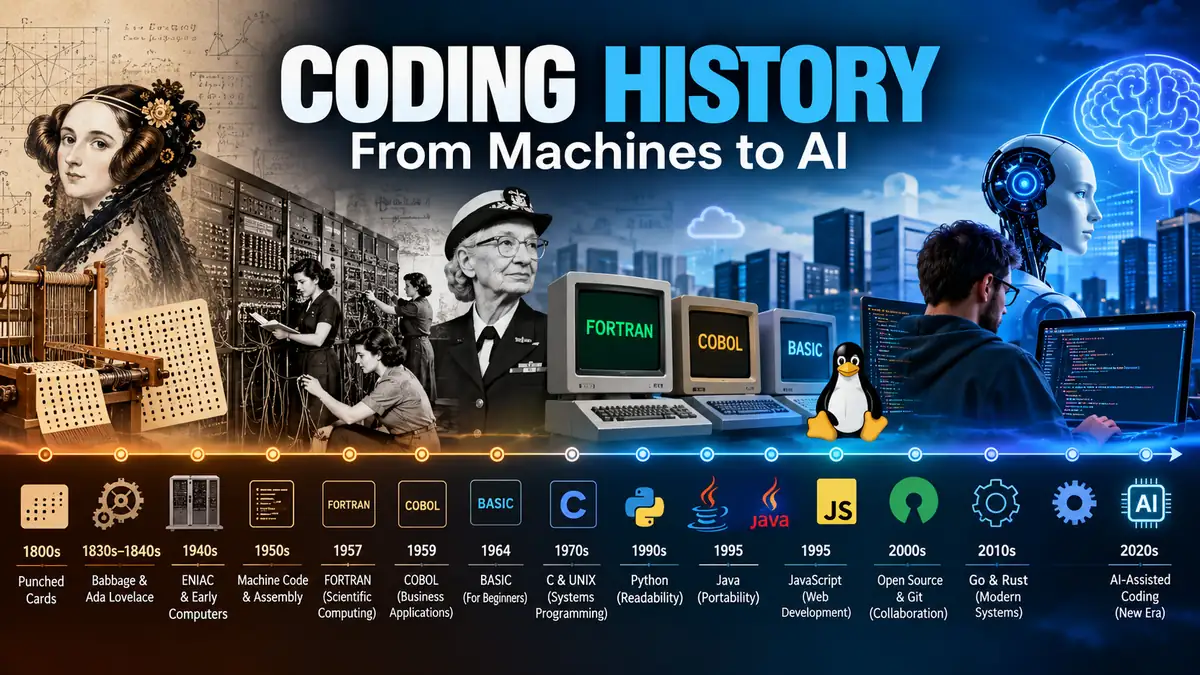

Coding feels inseparable from laptops, apps, websites, and artificial intelligence. Yet its intellectual roots reach back to the nineteenth century, long before an electronic computer existed.
The story of coding history is really the story of humans finding better ways to give machines precise instructions. It moves from mechanical devices and mathematical algorithms to machine code, assembly languages, compilers, high-level programming languages, the web, open-source software, cloud computing, and today’s AI-assisted development.
Coding history traces the evolution of instructions given to computing machines, beginning with nineteenth-century mechanical-computing concepts and developing through machine code, assembly, FORTRAN, COBOL, BASIC, C, Python, Java, JavaScript, and modern languages. Each generation made programming more accessible, portable, powerful, or safer while increasing the complexity of what software could accomplish.
What Is Coding and Where Did It Begin?
Coding is the process of expressing instructions in a form that a computer can execute, usually through a programming language.
Modern developers might write:
print("Hello, world!")A processor does not directly understand Python. Software ultimately translates or interprets those human-readable instructions into operations the machine can execute.
That translation layer is one of the central themes in coding history. Programming has repeatedly evolved by increasing the distance between human thinking and the physical details of the machine.
Early programmers often had to think about specific memory locations, processor instructions, switches, and hardware limitations. Modern developers can build websites, mobile applications, machine-learning systems, and distributed services without directly controlling individual electrical operations.
To understand how that happened, we need to go back before electronic computers.
The Origins of Coding Before Electronic Computers
Programming did not suddenly appear with the first PC. Several earlier inventions established the fundamental idea that a machine’s behavior could be controlled through encoded instructions.
The Jacquard Loom and Punched Instructions
In the early nineteenth century, Joseph-Marie Jacquard’s loom used punched cards to control weaving patterns.
The loom was not a general-purpose computer, but the underlying concept was significant: information encoded on a physical medium could determine what a machine did.
That principle would later reappear in computing. Punched cards became an important method of entering programs and data into computers during the twentieth century.
Charles Babbage and the Analytical Engine
British mathematician Charles Babbage designed the Analytical Engine during the nineteenth century.
Unlike a conventional calculator designed for one narrow task, Babbage envisioned a more general machine capable of performing different operations according to instructions.
The machine was never completed in Babbage’s lifetime, but its architecture anticipated concepts associated with later computers.
The Analytical Engine also introduced coding history to one of its most famous figures: Ada Lovelace.
Ada Lovelace and the First Published Computer Algorithm
In 1843, Ada Lovelace published an English translation of Luigi Menabrea’s description of Babbage’s Analytical Engine. Her extensive notes went far beyond a simple translation.
One section described a sequence of operations that could be used by the Analytical Engine to calculate Bernoulli numbers. The Computer History Museum describes these notes as containing the first published description of a stepwise sequence of operations for solving mathematical problems, which is why Lovelace is often called the first programmer. CHM
There is scholarly debate about the precise extent and originality of Lovelace’s contribution, so describing her simply as the uncontested inventor of programming can obscure a more complicated history. CHM
Her broader insight was arguably even more important.
Lovelace understood that a sufficiently general machine might manipulate symbols rather than merely calculate quantities. She imagined applications extending beyond conventional arithmetic, including music. NIST
That resembles a basic principle of modern computing: computers manipulate encoded information, whether that information represents numbers, words, photographs, sounds, video, or something else.
From Mechanical Ideas to Electronic Programming
The theoretical foundations of computing developed considerably during the first half of the twentieth century. By the 1940s, electronic computers were becoming practical machines.
Programming them was nothing like modern software development.
ENIAC and Programming With Wires and Switches
ENIAC, developed during World War II, became one of the landmark machines of early electronic computing.
Its original programming process involved physically configuring the machine using switches and cables. Columbia University’s computing history describes early ENIAC programming as plugging cables and setting switches rather than typing commands in a programming language. Columbia University
Six women became particularly associated with programming ENIAC: Kathleen McNulty, Jean Jennings Bartik, Betty Snyder Holberton, Marlyn Wescoff Meltzer, Frances Bilas Spence, and Ruth Lichterman Teitelbaum. Their work involved translating complex mathematical calculations into operations ENIAC could perform. CHM
Their contribution illustrates something easily overlooked when studying coding history: programming existed as a difficult technical profession before convenient programming languages existed.
The Stored-Program Breakthrough
An enormous conceptual improvement was storing program instructions in computer memory instead of physically rewiring a machine whenever its task changed.
The Manchester Small-Scale Experimental Machine, commonly called the Manchester “Baby,” demonstrated stored-program computing in 1948. According to the Computer History Museum, a 17-instruction program written by Tom Kilburn ran on June 21, 1948, making it the first program to run on a digital electronic stored-program computer. CHM
Software was becoming something that could be stored and changed as information.
That opened the door to increasingly sophisticated programming languages.
Machine Code: Programming in the Computer’s Own Instructions
At the lowest practical level, processors execute machine instructions represented digitally.
Early programmers frequently worked much closer to these instructions than modern programmers do.
Machine-language programming had serious limitations. Programs were difficult to write, understand, debug, and maintain. Code was also strongly tied to particular hardware architectures.
Imagine having to express a complicated mathematical calculation through long sequences of numeric instructions while manually tracking memory locations.
Errors could be extremely difficult to identify.
The obvious question became: could programmers communicate with computers using something easier?
The answer produced assembly language.
Assembly Language Makes Coding More Human-Readable
Assembly languages allowed programmers to use symbolic names and mnemonic instructions rather than representing every operation directly as numeric machine code.
Instead of remembering a raw processor instruction, a programmer could work with commands representing operations such as moving, adding, comparing, or jumping.
An assembler translates those symbolic instructions into machine code.
Assembly did not remove the need to understand computer architecture. Programs remained closely connected to particular processors.
But it established an important pattern that continues today:
Humans write a more understandable representation, and software translates it into something the computer can execute.
The next breakthrough pushed that abstraction much further.
Grace Hopper, Compilers, and the Rise of Higher-Level Programming
One of the transformative ideas in programming history was the compiler.
A compiler translates source code written in a programming language into another form, commonly machine-executable instructions or an intermediate representation.
Grace Hopper played a major role in this transition.
After working on early computers, Hopper joined the Eckert-Mauchly Computer Corporation. The Computer History Museum credits her with developing one of the world’s first compilers and compiler-based programming languages. She later played an important role in the development of COBOL. CHM
The compiler changed the economics of software development.
Instead of forcing humans to adapt completely to machine architecture, computers could perform part of the translation work.
This idea helped make high-level languages practical.
FORTRAN Changes the History of Programming
One of the biggest milestones in coding history arrived during the 1950s with FORTRAN.
John Backus led the IBM team responsible for its development.
Before FORTRAN, much programming was performed using machine or assembly language. IBM’s historical account describes how Backus assembled a team in 1953 to find a faster and less expensive approach to programming. IBM
FORTRAN—short for Formula Translation—was developed beginning in the 1950s and commercially released in 1957. It allowed scientists, engineers, and mathematicians to express calculations in a substantially more recognizable form. IBM
Instead of manually translating an entire scientific problem into low-level instructions, programmers could rely on the compiler.
This was not merely a convenience.
It changed who could realistically use computers.
Researchers could concentrate more heavily on the problem being solved instead of spending so much time managing machine-specific instructions.
FORTRAN became especially important in scientific and numerical computing, and descendants of the language remain in use.
COBOL Brings Programming Into Business
Scientific computing was only one major application for computers.
Businesses needed software for payroll, accounting, records, transactions, inventory, and large-scale data processing.
COBOL—Common Business-Oriented Language—was developed around these needs.
Grace Hopper participated in the efforts that led to COBOL, which emerged in 1959. Its comparatively English-like syntax was intended to make business programs understandable and portable across systems. The Computer History Museum describes COBOL as one of history’s most successful languages for business applications. CHM
FORTRAN and COBOL demonstrate how programming languages began specializing around different problems.
FORTRAN became strongly associated with scientific computing.
COBOL became deeply embedded in business data processing.
That specialization remains common today.
BASIC Makes Coding Accessible to Beginners
By the 1960s, another challenge had become clear.
Programming needed to become accessible beyond specialist computer scientists, mathematicians, engineers, and corporate data-processing departments.
John Kemeny and Thomas Kurtz at Dartmouth College developed BASIC—Beginner’s All-purpose Symbolic Instruction Code—with students as part of an effort to broaden access to computing.
At 4 a.m. on May 1, 1964, two BASIC programs successfully ran simultaneously through Dartmouth’s time-sharing system. Dartmouth credits BASIC and time-sharing with making computing available throughout its academic community and eventually far beyond the university. Dartmouth
BASIC later became closely associated with early personal computers.
For many people growing up during the personal-computer revolution, BASIC was their first opportunity to write code themselves.
C and UNIX Reshape Software Development
The early 1970s produced another enormously influential programming language: C.
Dennis Ritchie developed C at Bell Labs alongside the development of the Unix operating system.
Ritchie’s own historical account places C’s emergence between 1969 and 1973, with particularly intensive development during 1972. C evolved from B, which Ken Thompson had derived from BCPL. Nokia Corporation | Nokia
C achieved an unusual balance.
It provided higher-level structures than assembly while retaining enough low-level control for operating systems and performance-sensitive software.
That made it highly suitable for systems programming.
Unix was rewritten substantially in C, helping demonstrate that operating systems did not have to remain almost completely tied to assembly language and one specific machine.
Why C Became So Influential
C influenced both software engineering and later programming-language design.
Languages including C++, Java, C#, Objective-C, JavaScript, Go, and Rust either inherited syntax, concepts, or design influences directly or indirectly from the C tradition.
Many familiar constructs—including braces, semicolons, loops, functions, and operators—became widespread partly through this family of languages.
C remains important because it sits relatively close to the hardware while still providing meaningful abstraction.
Object-Oriented Programming Changes How Developers Organize Code
As software projects grew, programmers needed better ways to manage complexity.
Object-oriented programming became one influential answer.
Rather than organizing a program primarily as a sequence of procedures, object-oriented approaches structure software around objects containing data and associated behavior.
Languages such as Simula helped establish early object-oriented ideas, while Smalltalk developed the model much further.
C++ later combined object-oriented features with the C programming tradition.
The approach introduced concepts such as:
- classes
- objects
- encapsulation
- inheritance
- polymorphism
Object-oriented programming became especially influential in large application development during the 1980s, 1990s, and 2000s.
It was never the only programming paradigm, however.
Procedural, functional, declarative, logic, and data-oriented programming continued evolving alongside it.
That diversity is important: coding history is not a straight line in which every new paradigm replaces the previous one.
Personal Computers Transform Coding Culture
During the 1970s and 1980s, computing moved from universities, government laboratories, and large corporations into homes and small businesses.
Machines such as the Apple II, Commodore 64, IBM PC, and numerous other personal computers exposed millions of people to software.
Many systems included or supported BASIC interpreters.
A curious user could turn on a computer, type a small program, and immediately see the result.
This changed programming culturally as well as technically.
Coding was no longer something performed only by people with access to expensive institutional computers. Hobbyists and students could experiment at home.
The personal-computer era also accelerated commercial software development.
Word processors, spreadsheets, databases, games, graphics programs, and eventually large desktop operating systems created enormous demand for programmers.
The Internet Creates a New Era of Coding
The growth of computer networking—and especially the World Wide Web—changed programming again.
Developers increasingly needed software that communicated across networks and worked across different machines.
Several languages that remain important emerged or gained prominence during this period.
Python Prioritizes Readability
Guido van Rossum created Python at CWI in the Netherlands in the early 1990s as a successor to the ABC language. Python’s official history identifies releases 0.9.0 through 1.2 with the 1991–1995 period. Python.org
Python emphasized readable syntax and developer productivity.
For example:
for name in names: print(name)The syntax avoids much of the punctuation associated with languages from the C family.
Over time, Python found uses in web development, automation, scientific computing, education, data analysis, artificial intelligence, and machine learning.
Its success illustrates a recurring lesson from programming history: languages often gain adoption not simply because computers can execute them efficiently, but because humans can work productively with them.
Java and the Goal of Portability
Java emerged publicly during the mid-1990s after evolving from Sun Microsystems’ Oak project.
The Computer History Museum records Java’s introduction in 1995 and traces the project to Oak, created by James Gosling in 1991. CHM
Java’s architecture emphasized portability.
Rather than compiling applications exclusively for one hardware platform, Java programs could compile to bytecode executed through a Java Virtual Machine.
This supported the famous goal of running software across different systems with minimal modification.
Java subsequently became highly influential in enterprise applications, server software, education, and mobile development.
JavaScript Turns the Browser Into a Programming Platform
JavaScript also appeared in 1995.
Brendan Eich developed it at Netscape Communications. Despite the similar name, JavaScript and Java are distinct languages. CHM
JavaScript initially provided a way to make web pages interactive.
That modest-sounding capability became enormously significant.
Early websites were primarily documents. JavaScript allowed pages to respond dynamically to users, manipulate content, validate forms, communicate with servers, and eventually behave more like desktop applications.
As browsers improved, JavaScript became central to front-end web development.
Later server-side environments allowed JavaScript to run outside browsers as well.
The web had effectively become one of the world’s largest software platforms.
Open Source Changes How Code Is Built
Another major shift in coding history was organizational rather than syntactic.
Software development increasingly became collaborative on a global scale.
Open-source projects allow developers to inspect, modify, redistribute, and contribute to software according to their respective licenses.
Linux became one of the most prominent examples, but open-source development now reaches almost every part of modern computing.
Programming languages, operating systems, web servers, databases, frameworks, libraries, developer tools, and AI technologies frequently involve open-source components.
Version-control systems became essential for managing this collaboration.
Git, distributed code repositories, issue trackers, automated testing, code review, and continuous integration transformed coding from an individual activity into a structured team process.
A developer today can depend on thousands of lines of code written by contributors scattered across the world.
That would have been difficult to imagine during the punched-card era.
Modern Programming Languages Focus on New Problems
Programming languages continue to emerge because computing problems keep changing.
Two useful examples are Go and Rust.
Go and Large-Scale Software
Robert Griesemer, Rob Pike, and Ken Thompson began developing the ideas behind Go at Google in September 2007. The language was shaped partly by challenges involving large software systems, multicore processors, concurrency, tooling, and lengthy build processes. Go
Go deliberately keeps many aspects of the language simple while providing strong support for concurrent software and practical tooling.
Rust and Memory Safety
Rust represents another direction in modern systems programming.
Rust 1.0 was released on May 15, 2015, following years of development. Rust Blog
Its design combines performance-oriented systems programming with mechanisms intended to improve memory safety without requiring conventional garbage collection for ordinary memory management.
Rust also demonstrates how modern languages borrow rather than start from zero. Its official reference identifies influences ranging from C++ and Haskell to OCaml, Erlang, Scheme, Ruby, and other languages. Rust Documentation
This is typical of coding history.
New languages inherit decades of lessons from earlier ones.
A Coding History Timeline
| Period | Development | Why It Mattered |
|---|---|---|
| Early 1800s | Jacquard punched-card control | Demonstrated machine behavior controlled by encoded instructions |
| 1830s–1840s | Babbage’s Analytical Engine | Advanced the idea of a programmable general-purpose machine |
| 1843 | Ada Lovelace’s published notes | Described stepwise operations for the Analytical Engine |
| 1940s | ENIAC and early electronic computers | Programming became an electronic-computing profession |
| 1948 | Manchester Baby stored program | Demonstrated a program stored and executed electronically |
| 1950s | Compilers and assembly systems mature | Reduced dependence on raw machine instructions |
| 1957 | FORTRAN | Made high-level scientific programming practical |
| 1959 onward | COBOL | Expanded business-oriented programming |
| 1964 | BASIC | Helped make programming accessible to students and beginners |
| Early 1970s | C | Combined abstraction with efficient systems programming |
| 1980s | PCs and object-oriented programming expand | Broadened access and approaches to software development |
| 1990s | Python, Java, JavaScript | Supported productivity, portability, and web programming |
| 2000s | Open source, Git, cloud platforms | Changed collaboration and software deployment |
| 2010s | Go, Rust and modern ecosystems | Addressed concurrency, scale, tooling, and memory safety |
| 2020s | Generative AI coding tools | Added natural-language assistance to software development |
The dates tell only part of the story. Technologies overlap for decades. FORTRAN and COBOL did not disappear when C arrived, and C did not disappear when Python became popular.
Programming history is cumulative.
How Programming Languages Evolved
Looking across generations reveals a clear pattern.
1. Machine Dependence Decreased
Early code was closely tied to particular hardware.
High-level languages increasingly allowed developers to describe what they wanted accomplished while compilers and runtimes handled more of how the hardware should accomplish it.
2. Readability Improved
Machine instructions optimized communication with hardware.
Modern programming languages also optimize communication between humans.
Readable code matters because software is usually maintained, debugged, reviewed, and extended long after its original creation.
3. Portability Increased
Early programs could require extensive rewriting for another computer.
Standardized languages, compilers, virtual machines, interpreters, operating systems, containers, and web platforms progressively reduced this dependency.
4. Programming Became More Accessible
Programming moved from specialist laboratories to universities, corporations, homes, schools, smartphones, and browsers.
BASIC made coding easier for students. Python became popular in education. Web technologies made experimentation possible with little more than a browser and text editor.
5. Software Became More Collaborative
Early programmers could work directly with one machine.
Modern development may involve hundreds or thousands of contributors using version control, package repositories, automated tests, cloud infrastructure, and open-source libraries.
The programmer’s job consequently expanded beyond simply writing instructions.
Compiler vs Interpreter: An Important Historical Distinction
The development of translators is central to understanding coding.
A compiler generally transforms source code into another representation before execution. Traditional C development is a familiar example.
An interpreter executes or evaluates program instructions through another program, although modern implementations frequently combine interpretation and compilation techniques.
Some platforms use intermediate representations and virtual machines.
Java, for example, traditionally compiles source code into bytecode that can be executed by a Java Virtual Machine.
Modern language implementations therefore do not always fit neatly into a simple “compiled versus interpreted” binary.
The broader historical point is more important: programmers increasingly write abstractions that software tools translate into operations computers can perform.
Coding vs Programming: Are They the Same?
The terms are often used interchangeably, but they can carry slightly different meanings.
Coding usually refers specifically to writing source code using a programming language.
Programming can describe the wider process of developing software, including:
- defining requirements
- designing algorithms
- selecting data structures
- writing code
- debugging
- testing
- documenting
- deploying
- maintaining software
Someone writing a short Python script is coding.
Someone designing, implementing, testing, and maintaining an entire application is performing the broader work of programming or software development.
The distinction is useful but not absolute. Everyday conversation frequently treats both words as synonyms.
How the Role of a Programmer Changed
The earliest programmers often needed intimate knowledge of their machines.
Modern developers usually work through layers of abstraction:
Application → framework → libraries → runtime → operating system → machine instructions → hardware
Each layer represents accumulated work from previous generations of computing.
This has dramatically increased productivity.
A single developer can now build applications that would once have required specialized teams and expensive computing infrastructure.
But abstraction introduces new challenges.
Developers must understand APIs, frameworks, dependencies, security, networks, databases, cloud services, version control, automated deployment, and increasingly AI-assisted tools.
Programming became easier in some ways while software systems became vastly more ambitious.
The Rise of AI-Assisted Coding
Artificial intelligence represents the newest major chapter in coding history.
Traditional programming requires humans to explicitly write instructions using formal syntax.
Modern generative AI systems can accept natural-language requests and produce source code, explain existing programs, suggest tests, generate documentation, identify possible bugs, and assist with refactoring.
That changes the interface between programmer and machine again.
The progression can be simplified as:
switches → machine code → assembly → high-level languages → visual development tools → natural-language-assisted coding
Yet AI does not eliminate the need for software knowledge.
Generated code can contain logical errors, security weaknesses, outdated APIs, inefficient solutions, or incorrect assumptions. Developers still need to understand requirements, architecture, testing, security, and the behavior of the resulting software.
In practice, AI is becoming another abstraction layer.
Just as compilers reduced the need to manually translate high-level instructions into machine code, AI tools can reduce some of the manual work involved in translating human intentions into source code.
The comparison is imperfect, however. A compiler follows formally defined language rules, whereas generative AI produces probabilistic outputs that require verification.
What Coding History Teaches Modern Programmers
Studying programming history is more practical than it might appear.
It explains why languages look the way they do.
C helps explain syntax inherited by numerous later languages. Smalltalk and Simula help explain object-oriented programming. Lisp and functional-language traditions illuminate concepts increasingly found across modern languages. FORTRAN demonstrates why high-level abstraction was revolutionary rather than merely convenient.
History also shows that there is rarely one permanently “best” programming language.
Languages emerge in response to particular constraints.
FORTRAN addressed scientific computation.
COBOL targeted business processing.
BASIC emphasized accessibility.
C supported efficient systems programming.
Python prioritized readability and productivity.
Java emphasized portability and managed execution.
JavaScript addressed interactive web programming.
Go responded to challenges in large-scale software engineering and concurrency.
Rust places unusual emphasis on combining systems-level performance with memory-safety guarantees.
The practical lesson is simple: choose programming tools according to the problem rather than assuming newer automatically means better.
Why Old Programming Languages Still Matter
One of the most surprising aspects of coding history is how much old technology remains operational.
FORTRAN is still used in scientific and numerical computing. COBOL continues to exist in large institutional systems. C remains foundational to operating systems, embedded software, libraries, and performance-critical infrastructure.
Age alone does not make a language obsolete.
Replacing mature software can be expensive and risky, particularly when the existing system performs an essential task reliably.
Older languages also influence newer ones.
Programming evolves through inheritance. New languages borrow syntax, type systems, memory-management strategies, concurrency models, functional concepts, object systems, and tooling ideas from earlier research.
Modern coding is therefore built on layers of historical experimentation.
Where Coding Is Heading Next
No one can precisely predict the next stage of programming, but the historical direction is clear: humans keep searching for higher-level ways to express intent.
Early programmers controlled physical connections.
Later programmers wrote numeric instructions.
Assembly introduced symbolic commands.
High-level languages introduced increasingly human-readable abstractions.
Frameworks and libraries packaged common solutions.
Cloud platforms abstracted infrastructure.
AI-assisted development now allows portions of software creation to begin with natural-language descriptions.
Future programmers may spend less time manually producing routine syntax and more time defining requirements, evaluating generated solutions, designing architectures, integrating systems, testing behavior, and verifying security and correctness.
That does not necessarily mean source code disappears.
Earlier abstractions rarely erased everything beneath them. Python did not eliminate C. C did not eliminate assembly. High-level languages did not eliminate machine instructions.
Instead, each layer changed where most programmers spent their time.
The Continuing Story of coding history
The most important lesson from coding history is that programming has always been about abstraction.
Ada Lovelace explored how a theoretical machine could manipulate symbols. Early electronic programmers configured hardware directly. Assembly replaced many numeric instructions with symbolic ones. Compilers made languages such as FORTRAN practical. C helped portable systems programming flourish. BASIC expanded access. Python emphasized readability, Java promoted cross-platform execution, and JavaScript helped turn the web into an application platform.
Now AI-assisted tools are adding another interface between human intention and executable software.
The tools have changed dramatically, but the central challenge remains remarkably consistent: how can humans describe a problem precisely enough for a machine to help solve it?
Every major chapter in programming history has produced a new answer—and the next answer is still being written.
