

Finding a clear answer to a small English-language question can be surprisingly frustrating. A spelling may look right but feel wrong, two possessive forms may seem interchangeable, or a sentence may sound natural even though you are unsure about its grammar.
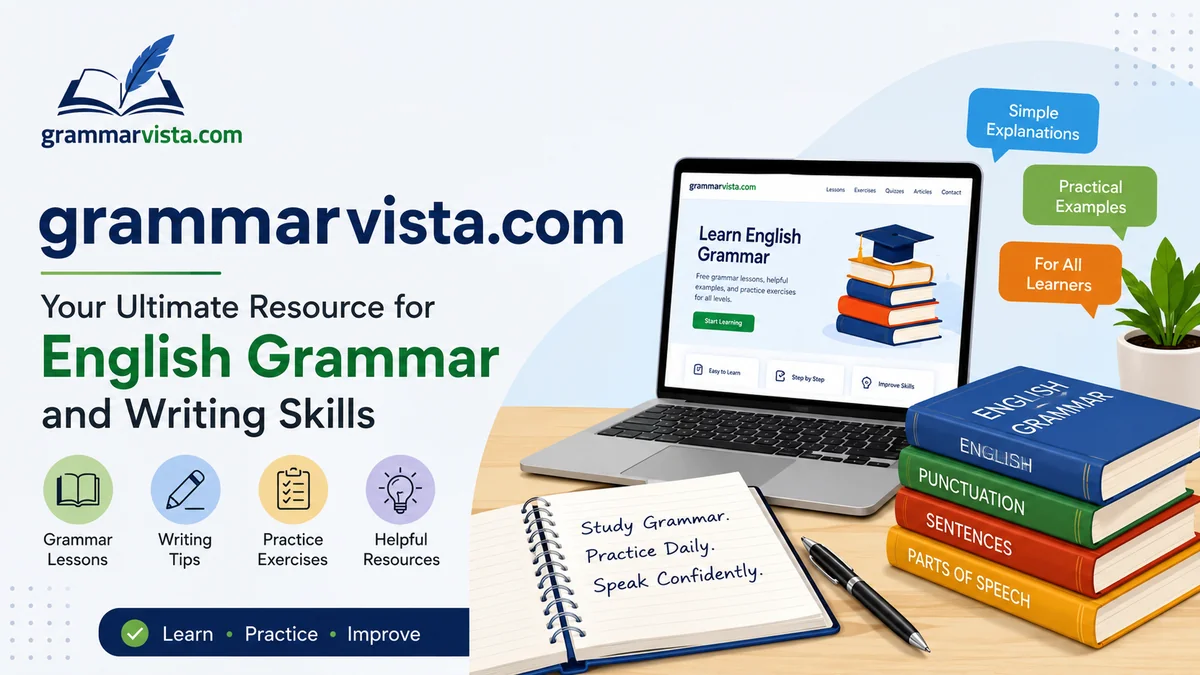
grammarvista.com is a content website that describes itself as an English grammar and vocabulary resource for students, professionals, and language enthusiasts. Its stated focus includes grammar guides, vocabulary development, corrections, punctuation, possessives, compound words, and sentence structure, although its current publishing activity also extends into broader general-interest subjects.
That last point matters. The name Grammar Vista suggests a narrowly focused language-learning website, but the current site is broader than its original grammar-centered positioning. Understanding that distinction makes it easier to decide what the website is useful for and how readers should evaluate information they find there.
What Is grammarvista.com?
grammarvista.com is the domain of Grammar Vista, an informational website originally positioned around English grammar, vocabulary, and writing improvement.
According to its About page, Grammar Vista’s mission is to make English-language concepts easier to understand and help readers communicate with greater confidence and precision. The website says its intended audience includes students, professionals, and general language enthusiasts.
Its language-focused material covers areas such as:
- English grammar rules
- Vocabulary
- Punctuation
- Possessive forms
- Compound words
- Sentence structure
- Common language mistakes
- Word usage
- Writing clarity
- Synonyms and antonyms
- Context-specific vocabulary
The website’s own description says its guides range from basic grammar rules to more advanced concepts and use explanations, examples, and practical tips to help readers understand how English works.
However, anyone visiting grammarvista.com in 2026 should recognize that this description does not capture everything currently published on the domain.
Grammar Vista has expanded beyond grammar
The current homepage and blog contain articles covering subjects outside English-language education.
Recent posts visible in August 2026 include material about mental-health technology, stump removal, 3D printing, South African music, Instagram tools, TikTok downloaders, foundation repair, AI design workflows, and veterinary care.
Older sections of the blog still show grammar-oriented content. For example, archived pages classify conversational English articles under the Grammar category.
A more accurate description, therefore, is that Grammar Vista is a general informational publication with roots in grammar and English-language education, rather than a website currently limited exclusively to grammar.
What Does grammarvista.com Offer?
The site’s stated educational purpose can be divided into several core areas.
| Area | What readers can expect |
|---|---|
| Grammar | Explanations of English rules and common mistakes |
| Vocabulary | Word meanings, alternatives, and usage guidance |
| Punctuation | Guidance on punctuation and written clarity |
| Possessives | Explanations of apostrophes and possessive forms |
| Compound Words | Guidance on combined, hyphenated, and separate forms |
| Sentence Structure | Help understanding how English sentences are formed |
| Corrections | Explanations of potentially confusing language choices |
| General Content | Articles covering technology, entertainment, news, business, pets, and other subjects |
The site’s footer continues to highlight Grammar, Punctuation, Compound Words, Possessives, and Sentence Structure as its top categories, reinforcing its language-learning identity even while newer editorial coverage has become much broader.
Grammar guides
Grammar rules become useful when they are connected to actual sentences rather than presented as definitions to memorize.
Grammar Vista says its grammar guides are intended to provide explanations, practical examples, and tips across different learning levels.
For a reader, this type of resource is most valuable when trying to answer questions such as:
- Which grammatical form is correct?
- Why does a particular sentence sound awkward?
- Where should an apostrophe go?
- Is a word singular, plural, or possessive?
- Which expression fits a particular context?
- How should a sentence be structured?
These are reference-style questions. Most people do not need an entire English course to answer them; they need a focused explanation and enough examples to understand the underlying rule.
Vocabulary resources
Vocabulary knowledge is more than knowing dictionary definitions.
A writer may know what a word means while still being unsure whether it sounds natural in a particular sentence. Tone, register, connotation, collocation, and context all affect word choice.
Grammar Vista states that its vocabulary material can include thematic lists, usage tips, synonyms, antonyms, and explanations of context-specific usage.
This type of material can help readers distinguish between words that appear similar but are not always interchangeable.
Grammar and vocabulary corrections
Corrections are particularly useful for learners because they connect a rule to a recognizable mistake.
Grammar Vista identifies misused tenses, subject-verb agreement, and confusing word choices among the types of problems its correction material aims to address.
For example, simply telling someone that subject-verb agreement exists is less useful than demonstrating why:
The list of items is on the desk.
uses is rather than are.
The grammatical subject is list, not items. Examples like this reveal the logic behind a correction and make the rule easier to apply elsewhere.
Who Is grammarvista.com Designed For?
The official About page identifies students, professionals, and language enthusiasts as intended readers. In practice, the language-related material can potentially serve a wider group.
Students and English learners
Students frequently encounter grammar questions while writing assignments, preparing presentations, composing emails, or studying English as an additional language.
A focused online explanation can help clarify concepts such as verb tense, punctuation, possessives, sentence construction, and vocabulary.
The strongest learning approach is not simply to copy the corrected form. Readers should understand why one construction works and another does not.
That distinction turns a quick lookup into reusable knowledge.
Writers and content creators
Writers regularly face questions that ordinary spell-checking cannot fully resolve.
A word can be spelled correctly but used incorrectly. A sentence can be grammatically acceptable yet unnecessarily confusing. An apostrophe can completely change meaning.
Grammar references can therefore function as a second-stage check after drafting.
The practical workflow is simple:
- Write the sentence naturally.
- Identify the exact point of uncertainty.
- Look up the underlying grammar or usage rule.
- Compare multiple examples.
- Rewrite the sentence in your own context.
- Read it again for meaning and clarity.
This works better than mechanically accepting every suggested correction from an automated tool.
Professionals
Professional communication places a premium on clarity.
Emails, reports, proposals, presentations, policies, documentation, and client communications can lose credibility when grammatical errors obscure the intended meaning.
Professionals generally do not need to become linguists. They need reliable answers to specific questions.
For this audience, resources covering punctuation, sentence structure, word choice, and usage can be particularly practical.
Teachers and educators
Educators may also encounter Grammar Vista pages while searching for examples or simplified explanations.
However, teaching material should be verified carefully before being incorporated into formal lessons. English contains exceptions, regional variations, style conventions, and disputed usage rules that cannot always be reduced to one universally correct answer.
How Can grammarvista.com Help With English Grammar?
The best way to use grammarvista.com is as a reference resource rather than an unquestionable authority.
Suppose you are uncertain about a possessive construction. Instead of searching only for the “correct answer,” examine the explanation behind the apostrophe placement.
Ask:
Who or what possesses something?
Then determine whether the noun is singular or plural.
Consider:
- the student’s book — one student
- the students’ books — multiple students
- the children’s books — irregular plural
Understanding the pattern is more valuable than memorizing three examples.
The same principle applies to punctuation, sentence structure, vocabulary, compound words, and other language questions.
Search for the smallest possible problem
Broad searches such as “learn English grammar” often return enormous guides.
A more effective approach is to isolate the uncertainty.
Instead of searching for English punctuation, search for the specific concept you need, such as the difference between a semicolon and comma.
Instead of searching for possessive grammar, identify the exact noun or construction causing confusion.
Specific questions produce explanations that are easier to understand and apply.
Compare examples, not just definitions
A grammatical definition can be technically accurate while remaining difficult to use.
Examples provide context.
When reading a grammarvista.com article—or any other grammar resource—look for examples that demonstrate:
- correct usage;
- incorrect usage;
- why the incorrect version fails;
- exceptions to the general rule;
- differences caused by context.
If an article provides only a declaration that one form is correct, consider verifying it elsewhere before treating the answer as definitive.
What Topics Can You Find on Grammar Vista?
The website currently has two identities that overlap: its established language-learning focus and its broader publishing activity.
Traditional language topics
The site’s navigation and About information emphasize several language categories.
Grammar
Grammar governs how words interact to form meaningful phrases, clauses, and sentences.
Typical grammar questions concern subjects and verbs, pronouns, articles, modifiers, tense, agreement, and sentence construction.
Punctuation
Punctuation helps readers understand relationships between ideas.
Commas, semicolons, colons, apostrophes, quotation marks, hyphens, parentheses, and dashes perform different functions. Small punctuation changes can sometimes alter a sentence’s meaning.
Compound words
English compounds can be written in three general ways:
- Closed: notebook
- Hyphenated: well-known
- Open: post office
The difficulty is that English does not provide one simple rule that predicts the accepted spelling of every compound. Usage also changes over time.
Possessives
Possessives are a common source of uncertainty because apostrophe rules interact with singular nouns, regular plurals, irregular plurals, names, and style conventions.
Sentence structure
Sentence structure deals with the organization of clauses, subjects, predicates, modifiers, and other elements.
Learning structure can help writers diagnose fragments, run-on sentences, misplaced modifiers, and confusing constructions.
Broader editorial topics
Current Grammar Vista content goes substantially beyond these areas.
The site’s August 2026 blog archive includes content related to technology, health, home services, entertainment, social-media tools, design, pets, and other general-interest subjects.
This is worth knowing if you reached grammarvista.com expecting every page on the domain to have been produced specifically by an English-language education publication.
A domain’s historical niche does not automatically establish expertise in every subject subsequently published on it.
Is grammarvista.com an Automated Grammar Checker?
Readers should distinguish between educational grammar content and an interactive grammar-checking application.
Grammar Vista’s own About page describes guides, vocabulary resources, corrections, articles, and educational content. It does not present the site’s core offering there as a real-time automated writing assistant.
This distinction matters because some third-party descriptions characterize grammarvista.com as if it were an advanced automated text-analysis or syntactical editing platform. That characterization is not consistent with the functionality described on Grammar Vista’s own About page.
Based on the site’s first-party information, it is more accurate to describe Grammar Vista primarily as a content and reference website.
That is different from software that accepts a document and automatically analyzes spelling, grammar, tone, readability, and style.
Is grammarvista.com Free to Access?
The public articles and informational pages examined for this guide are accessible through the website without an indicated subscription requirement.
Its Terms of Service describe access to site content and provide users with a limited license for personal, non-commercial use. The Terms also state an eligibility requirement of at least 13 years old.
Availability can change, however, so readers should rely on the current website when determining whether a particular feature or resource requires registration or payment.
Is grammarvista.com Reliable?
There is no useful one-word answer to this question.
Reliability should be assessed article by article and claim by claim, especially because Grammar Vista now publishes across multiple subject areas.
The website says its content is produced by language experts, writers, and educators and describes its information as accurate and aligned with current language standards.
At the same time, its own disclaimer says its material is provided for general informational purposes and that it cannot guarantee all content is complete, current, or error-free. It also says the site’s material should not substitute for professional legal, financial, or academic advice.
Those two statements should be considered together.
How to evaluate a Grammar Vista article
Before relying heavily on a page, check five things.
1. Does the article explain the rule?
A reliable grammar article should do more than announce an answer.
2. Are examples provided?
Examples make it possible to test whether the explanation holds in actual usage.
3. Does the author distinguish rules from style preferences?
Not every English disagreement has one absolute answer. Style guides can differ on capitalization, punctuation, possessives, numbers, and other conventions.
4. Is the information current?
Language evolves. Dictionaries and editorial style guides periodically update accepted forms and recommendations.
5. Does the subject match the site’s demonstrated expertise?
This is particularly relevant now that grammarvista.com publishes articles far outside grammar and vocabulary.
A straightforward punctuation explanation and an article involving health, finance, legal matters, or another high-stakes subject should not be evaluated with the same standard.
Does Grammar Vista Use American or British English?
English-language websites often attract international readers, which creates another practical issue: American English and British English are not identical.
Differences can appear in:
| American English | British English |
| color | colour |
| center | centre |
| traveling | travelling |
| organize | organise/organize |
| defense | defence |
Punctuation conventions and vocabulary can differ as well.
A spelling that appears incorrect to an American reader may be completely standard in British English.
For this reason, readers should determine which variety of English a particular explanation assumes before applying it universally.
The Grammar Vista disclaimer states that its governing law is that of New York, United States, but a legal jurisdiction should not itself be treated as proof that every language article follows a specific American editorial style guide.
When consistency matters—for example, in an academic paper or professional publication—follow the English variety and style guide required by your institution or publisher.
How Does Grammar Vista Compare With Dictionaries and Style Guides?
A website like grammarvista.com serves a different purpose from a dictionary or formal style manual.
A dictionary primarily documents words: spelling, pronunciation, meaning, grammatical category, etymology, and usage.
A style guide establishes conventions for writing and editing within a particular context.
A grammar-learning website typically explains concepts in more accessible language.
That makes the resources complementary rather than interchangeable.
When a grammar article is enough
A clear explanatory article may be sufficient when you want to understand:
- a basic punctuation rule;
- a common possessive form;
- a sentence construction;
- an everyday word distinction;
- a compound-word convention;
- a common grammatical error.
When you should verify elsewhere
Cross-check the answer when:
- competing sources disagree;
- academic marks depend on the answer;
- a publisher requires a specific style;
- the usage appears regional;
- the rule has known exceptions;
- terminology is highly technical;
- the information concerns health, law, finance, safety, or another consequential subject.
This is not unique to Grammar Vista. It is good information-literacy practice for virtually every general educational website.
Can grammarvista.com Improve Your Writing?
A grammar website can help improve writing, but reading grammar articles alone will not make someone a strong writer.
Writing improvement requires application.
A useful routine is:
- Write first. Get your meaning onto the page.
- Review for clarity. Make sure each sentence communicates what you intended.
- Identify uncertainty. Mark grammar, punctuation, and word choices you are unsure about.
- Research the rule. Use grammar resources to understand the issue.
- Correct the sentence yourself. Applying the rule helps you remember it.
- Read the revision aloud. Awkward rhythm often exposes problems that visual proofreading misses.
- Check consistency. Keep spelling, capitalization, punctuation, and style consistent throughout the document.
The key step is number five.
Copying a correction solves one sentence. Understanding the reason behind it can solve hundreds of future sentences.
Grammar is only one part of good writing
Technically correct writing can still be poor communication.
Strong writing also depends on:
- clarity;
- organization;
- appropriate vocabulary;
- logical progression;
- sentence variety;
- concision;
- audience awareness;
- tone;
- context.
Consider:
Due to the fact that the meeting experienced a postponement, we are presently in the process of determining an alternative date.
It can be simplified to:
Because the meeting was postponed, we’re choosing a new date.
The improvement is not primarily about fixing grammar. It is about making the meaning easier to process.
That is why grammar should support communication rather than become an end in itself.
Common Mistakes When Using Online Grammar Resources
Online grammar references are convenient, but they can be misused.
Treating every recommendation as an absolute rule
Some writing choices are stylistic rather than grammatical.
The Oxford comma is a familiar example. Different style systems have different preferences.
Readers should learn to ask:
Is this actually grammatically incorrect, or does a particular style guide simply prefer another form?
That question prevents a lot of unnecessary confusion.
Ignoring context
Words rarely exist independently of context.
Two synonyms can share a dictionary definition while carrying different levels of formality or emotional meaning.
Likewise, a sentence structure that works in conversation may be inappropriate in a formal research paper.
Correcting without understanding
Automated tools and quick-answer articles make it tempting to replace text immediately.
A better habit is to understand the reason for the change.
If you cannot explain why the correction is preferable, you probably have not learned the rule yet.
Depending on one website for everything
No single online publication should be your only authority for every language question.
When accuracy matters, compare a grammar explanation with established dictionaries, institutional writing resources, or the style manual relevant to your work.
This becomes even more important when the website you are using publishes across many unrelated subject areas.
What Should You Know About the Current Grammar Vista Website?
Several facts help put the site into context.
Grammar Vista’s first-party pages continue to present the brand as a resource for mastering English grammar and vocabulary. The site says its mission involves effective communication, grammar education, vocabulary development, corrections, and accessible language-learning resources.
Its footer likewise continues to identify Grammar, Punctuation, Compound Words, Possessives, and Sentence Structure as major categories.
Yet its current homepage and blog prominently feature general-interest articles unrelated to English instruction.
That creates an important distinction:
Grammar Vista’s stated brand identity remains language-focused, while its current editorial footprint is much broader.
Readers researching grammar can still encounter relevant archived material, but they should not assume that every article on grammarvista.com concerns English education or represents specialist linguistic guidance.
How to Use grammarvista.com Effectively
For language-related research, a simple process works well.
1. Identify your exact question
Do not begin with a huge topic if your problem is narrow.
Find the specific word, punctuation mark, grammatical construction, or sentence pattern causing uncertainty.
2. Read the explanation before copying the answer
Look for the rule behind the recommendation.
3. Study the examples
Compare the examples with your own sentence and determine whether the contexts genuinely match.
4. Watch for exceptions
English contains plenty of irregular forms and conventions.
A rule described as universal deserves extra scrutiny if familiar examples appear to contradict it.
5. Distinguish grammar from style
Ask whether the recommendation is required for grammatical correctness or simply preferred under a particular editorial convention.
6. Cross-check important answers
For school, professional publishing, or other important work, verify uncertain claims against an authoritative dictionary, institutional language resource, or relevant style guide.
7. Apply the principle yourself
Finally, return to your original sentence and make the correction without simply copying an example.
That last step converts browsing into learning.
Quick Takeaway: Use Grammar Vista as a starting point for understanding language questions. Focus on explanations and examples, distinguish grammar rules from style preferences, and verify important or disputed points with authoritative references.
The Role of Grammar Websites in Modern Writing
Grammar resources occupy an interesting position now that writers have access to spell-checkers, automated editors, generative AI, dictionaries, search engines, and writing assistants.
It might seem as though explanatory grammar websites should have become unnecessary.
The opposite is often true.
Software can suggest a correction immediately, but a suggestion does not necessarily teach the user why the original sentence was problematic.
Human-readable explanations fill that gap.
The most useful grammar resource is therefore not necessarily the one that corrects the greatest number of sentences. It is the one that helps readers recognize the same problem themselves next time.
This is particularly valuable for English learners.
Repeatedly understanding patterns—rather than merely accepting corrections—builds an intuitive sense of sentence structure, punctuation, and word choice.
Final Thoughts on grammarvista.com
grammarvista.com is best understood as the website of Grammar Vista, a publication whose stated mission centers on English grammar, vocabulary, corrections, and clearer communication. Its established categories include grammar, punctuation, compound words, possessives, and sentence structure, while its current blog also publishes a substantial amount of broader general-interest content.
For readers interested in English, the most useful approach is to treat Grammar Vista as a reference and learning resource rather than a substitute for every dictionary, style manual, teacher, or specialist source.
Search for the exact language problem you are trying to solve, understand the explanation behind the answer, study examples, watch for regional and stylistic differences, and cross-check anything important or disputed.
Used that way, grammarvista.com can be part of a broader process for developing stronger grammar awareness, more precise vocabulary, and—most importantly—clearer writing.
