
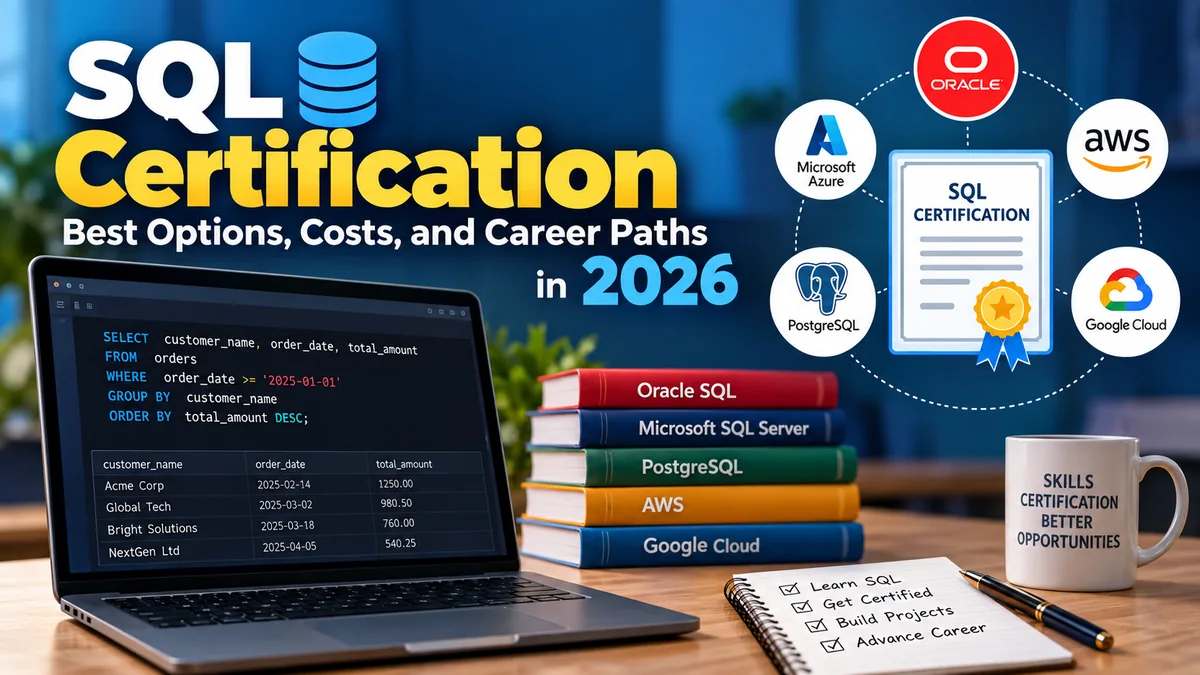

SQL is one of those technical skills that looks simple at first and becomes more valuable the deeper you go. Writing a basic SELECT query may take minutes to learn, but working confidently with joins, subqueries, window functions, database design, performance, security, and production data takes real practice.
A sql certification can provide structured evidence of that knowledge. The challenge is choosing the right credential. There is no single universal SQL certification because SQL is a standardized language implemented across platforms such as Oracle Database, Microsoft SQL Server, PostgreSQL, MySQL, Snowflake, and cloud data services.
Quick answer: A sql certification is a credential that validates SQL, relational database, analytics, or database-platform knowledge through an exam or practical assessment. The best choice depends on your career goal: vendor-neutral skills for analysts, Oracle SQL for Oracle environments, Microsoft credentials for Azure SQL, or broader cloud certifications for data engineering roles.
What Is a SQL Certification?
A SQL certification is a professional credential demonstrating knowledge of Structured Query Language, relational databases, or a particular database ecosystem.
Not every credential tests the same thing.
Some focus heavily on writing SQL queries. Others test database administration, security, performance optimization, cloud architecture, data pipelines, or analytics alongside SQL.
This distinction matters because a certificate of course completion and a proctored professional certification do not carry the same signal.
Common credential types include:
- SQL skill certifications: Test querying and data analysis directly.
- Vendor certifications: Focus on platforms such as Oracle Database or Microsoft Azure SQL.
- Cloud data certifications: Cover databases as part of broader data engineering responsibilities.
- Course certificates: Confirm that you completed structured SQL training.
- Coding assessments: Demonstrate practical query-writing ability through online challenges.
Before choosing one, ask what you actually want the credential to prove.
Best SQL Certification Options in 2026
There is no universally “best” option. Current certification paths range from SQL-focused assessments to database-administration and cloud-data credentials. The strongest choice is usually the one that matches the technology used in the jobs you want.
| Certification | Level | Main Focus | Best For |
|---|---|---|---|
| DataCamp SQL Associate | Beginner–Intermediate | Practical SQL and data analysis | Data analysts |
| Oracle Database SQL Certified Associate | Intermediate | Oracle SQL | Oracle database roles |
| Microsoft Azure Data Fundamentals (DP-900) | Beginner | Cloud and relational data fundamentals | Beginners using Azure |
| Azure Database Administrator Associate (DP-300) | Intermediate | Azure SQL and SQL Server administration | Database administrators |
| AWS Certified Data Engineer – Associate | Intermediate | Cloud data engineering | AWS data engineers |
| Google Professional Cloud Database Engineer | Advanced | Cloud database architecture | Experienced database professionals |
The important point is that these credentials serve different purposes. An analyst who spends most of the day querying datasets has different certification needs from a database administrator responsible for high availability and security.
1. DataCamp SQL Associate Certification
The DataCamp SQL Associate Certification is one of the more accessible choices for people who want to demonstrate practical SQL ability without committing to a particular enterprise database vendor.
The certification currently involves a timed assessment and a practical examination. DataCamp says its assessment covers areas including database concepts, data extraction, joins, aggregation, data quality, cleaning, and exploratory analysis using PostgreSQL.
That practical component is useful because SQL is ultimately a hands-on skill.
Who should consider it?
It makes the most sense for:
- Aspiring data analysts
- Business analysts
- Students
- Career changers
- Professionals who use SQL for reporting
- People building their first data portfolio
A vendor-neutral or skills-oriented credential can be useful when you do not yet know whether your future employer will use Oracle, Microsoft SQL Server, PostgreSQL, or another database system.
The limitation is employer recognition. A platform assessment may demonstrate SQL ability, but an organization operating a large Oracle or Microsoft environment may value certification in its existing technology stack more highly.
2. Oracle Database SQL Certified Associate
Oracle’s SQL certification path has long been associated with enterprise database environments. It is particularly relevant when a current or prospective employer uses Oracle Database.
Oracle SQL involves familiar relational concepts—tables, joins, filtering, aggregation, subqueries, functions, and data manipulation—but it also includes Oracle-specific behavior and syntax.
This makes an Oracle credential more specialized than a general SQL course certificate.
Skills worth mastering for Oracle SQL
Preparation typically requires confidence with:
- SELECT statements
- WHERE and ORDER BY clauses
- Single-row and group functions
- INNER and OUTER joins
- Subqueries
- Set operators
- DDL
- DML
- Constraints
- Views
- Indexes
- Data types
- Database objects
Do not choose Oracle simply because its credential appears frequently on “best certification” lists.
Choose it when Oracle Database is relevant to the jobs you have or want.
That simple rule can save months of studying material that has little connection to your target role.
3. Microsoft Azure Data Fundamentals (DP-900)
Microsoft Azure Data Fundamentals is a beginner-level credential rather than a pure SQL examination.
Microsoft describes DP-900 as covering core data concepts, relational data on Azure, non-relational data, and analytics workloads. The current exam is intended for candidates beginning to work with cloud data, and Microsoft lists a 45-minute assessment.
That broader scope makes DP-900 useful for someone who needs to understand where SQL fits into a modern cloud data environment.
DP-900 is a good fit if you:
- Are new to data careers
- Want an introduction to relational databases
- Work in a Microsoft environment
- Plan to learn Azure SQL
- Need cloud-data fundamentals
- Want a foundation before pursuing a more technical Microsoft credential
Do not expect DP-900 alone to prove advanced SQL ability.
Its value comes from establishing foundational knowledge of data concepts and Microsoft’s Azure ecosystem.
4. Microsoft Azure Database Administrator Associate (DP-300)
For database administrators, Microsoft Certified: Azure Database Administrator Associate is considerably more specialized.
The certification centers on Azure SQL services and SQL Server environments. Microsoft lists responsibilities including management, availability, security, performance monitoring, optimization, migration, automation, and high availability/disaster recovery. Candidates also use Transact-SQL, or T-SQL, as part of database administration.
This makes DP-300 substantially different from a beginner SQL certificate.
It is aimed at people who manage databases rather than people who only query them.
Microsoft currently identifies it as an intermediate credential, with a 12-month renewal frequency. Role-based certifications can be renewed through Microsoft’s online renewal assessment.
Who benefits most?
DP-300 is worth considering for:
- SQL Server DBAs
- Azure database administrators
- Infrastructure professionals
- Cloud database specialists
- Professionals migrating SQL Server workloads to Azure
If your target job description repeatedly mentions Azure SQL Database, SQL Server, Azure SQL Managed Instance, backup, security, performance tuning, and high availability, DP-300 aligns much more closely than a general SQL course.
5. AWS Certified Data Engineer – Associate
AWS Certified Data Engineer – Associate (DEA-C01) is another credential commonly encountered when researching SQL careers, but it is not a dedicated SQL certification.
AWS says the exam validates skills involving data pipelines as well as monitoring, troubleshooting, cost, and performance optimization. Its domains cover data ingestion and transformation, data-store management, data operations and support, and data security and governance.
SQL therefore forms part of a much larger data-engineering skill set.
A data engineer might work with relational databases and SQL alongside:
- Amazon Redshift
- Amazon RDS
- Data lakes
- ETL/ELT pipelines
- Data ingestion
- Transformation workflows
- IAM and security
- Monitoring
- Storage systems
- Data governance
Choose this route when your objective is data engineering on AWS—not simply learning how to write SQL.
6. Google Professional Cloud Database Engineer
Google’s Professional Cloud Database Engineer is an advanced database credential designed for experienced professionals.
Google states that the certification assesses the ability to design scalable and highly available database solutions, manage database solutions, migrate data, and deploy scalable cloud databases. The company recommends five or more years of overall database and IT experience, including two years working with Google Cloud database solutions.
The exam is currently two hours long with 50–60 multiple-choice and multiple-select questions, and Google lists a $200 registration fee before applicable taxes.
This is clearly not the ideal starting point for someone who has just learned SELECT, WHERE, and GROUP BY.
It fits professionals working with production databases and cloud infrastructure.
Which SQL Certification Is Best for Beginners?
For a complete beginner, the first priority should be learning SQL rather than collecting credentials.
Start with the language itself.
You should be comfortable querying a relational database before worrying about an exam.
A sensible learning sequence is:
- Learn tables, rows, columns, schemas, and relational database concepts.
- Practice SELECT, WHERE, ORDER BY, LIMIT, and DISTINCT.
- Learn aggregate functions and GROUP BY.
- Practice INNER, LEFT, RIGHT, and FULL joins where supported.
- Learn subqueries and common table expressions.
- Understand INSERT, UPDATE, and DELETE.
- Practice CASE expressions and data cleaning.
- Learn window functions.
- Build small projects using realistic datasets.
- Choose a certification aligned with your desired role.
For beginners interested in Microsoft’s ecosystem, DP-900 provides a structured introduction to cloud data concepts. Microsoft explicitly positions it for candidates beginning to work with data in the cloud.
For people primarily interested in query-writing and analytics, a practical SQL assessment may provide a more direct measure of the skill they want to demonstrate.
SQL Certification for Data Analysts
Data analysts usually need a different skill set from database administrators.
An analyst commonly uses SQL to answer questions such as:
- Which products generated the most revenue?
- How did customer retention change this quarter?
- Which marketing channels produced the highest conversion rate?
- What is the average order value by customer segment?
- Which customers have stopped purchasing?
For this type of work, practical query ability matters enormously.
SQL skills analysts should master
A strong analyst should understand:
Filtering and sorting
You need to retrieve exactly the records required rather than dumping an entire table.
Joins
Real business questions almost always involve multiple tables—customers, transactions, products, campaigns, employees, or inventory.
Aggregation
Functions such as COUNT(), SUM(), AVG(), MIN(), and MAX() turn raw records into useful metrics.
Common table expressions
CTEs can make complex analytical queries easier to structure and maintain.
Window functions
Functions such as ROW_NUMBER(), RANK(), LAG(), LEAD(), and running aggregates are extremely useful for analytical work.
Data cleaning
Real datasets contain missing values, duplicates, inconsistent formats, and unexpected records.
A certificate helps most when it confirms these skills rather than replacing them.
SQL Certification for Database Administrators
Database administration requires much more than writing queries.
DBAs may be responsible for:
- Database installation and configuration
- User permissions
- Authentication
- Backup and recovery
- Monitoring
- Index management
- Query performance
- Availability
- Disaster recovery
- Security
- Database migration
- Automation
That is why platform-specific certifications become more valuable at this level.
Microsoft’s DP-300, for example, explicitly covers security, database resources, monitoring and optimization, automation, and high availability/disaster recovery.
For an Oracle-focused DBA, an Oracle path makes more sense.
The technology stack should drive the certification choice.
SQL Certification for Data Engineers
Data engineering expands the scope again.
SQL remains fundamental, but engineers often need to move, transform, store, model, and monitor data across large systems.
Relevant concepts include:
- ETL and ELT
- Data warehouses
- Data lakes
- Batch processing
- Streaming data
- Data modeling
- Pipeline orchestration
- Cloud storage
- Data quality
- Security and governance
AWS’s current Data Engineer Associate certification reflects this broader responsibility: its exam domains span ingestion and transformation, storage, operations, and governance rather than SQL syntax alone.
For this career path, becoming excellent at SQL is necessary, but SQL should be combined with Python, cloud platforms, data modeling, and pipeline technologies.
How Much Does SQL Certification Cost?
Costs vary substantially because “SQL certification” describes several different types of credentials.
Some skills assessments are included with learning subscriptions. Professional vendor exams may cost around $100–$200 or more, depending on the credential and country.
For example, Microsoft currently lists DP-900 at $99 USD based on the region in which the exam is proctored, while DP-300 is listed at $165 USD in the U.S.; regional pricing can differ. Google lists its Professional Cloud Database Engineer exam at $200 plus applicable tax.
Always check the official certification provider before paying.
Prices, exam versions, policies, and available credentials can change.
Also calculate the total cost rather than only the examination fee. Your real investment can include:
- Training courses
- Practice tests
- Books
- Lab environments
- Cloud usage
- Exam retakes
- Subscription fees
- Renewal requirements
A cheaper credential is not automatically better value, and an expensive exam is not automatically more respected.
How Long Does It Take to Get SQL Certified?
There is no universal preparation period.
Someone who already writes SQL every day may need only focused exam preparation. Someone starting from zero may need several months to develop genuine competency.
Your timeline depends on:
- Existing SQL knowledge
- Database experience
- Certification difficulty
- Study hours per week
- Programming background
- Hands-on practice
- Familiarity with the vendor platform
A beginner should avoid rushing directly from a short tutorial into an intermediate certification exam.
Build the skill first.
Then use the exam objectives as a checklist for finding gaps in your knowledge.
What Does a SQL Certification Exam Cover?
The content depends heavily on the certification.
A SQL-focused assessment may test:
Query fundamentals
SELECT first_name, last_name
FROM customers
WHERE country = 'Canada'
ORDER BY last_name;
You should understand what each clause does and how changing the query affects its result.
Joins
SELECT c.customer_name, o.order_date
FROM customers c
JOIN orders o
  ON c.customer_id = o.customer_id;
Joins are fundamental because relational data is deliberately distributed across related tables.
Aggregation
SELECT category, SUM(revenue) AS total_revenue
FROM sales
GROUP BY category;
Aggregation is particularly important in analytics and reporting.
Subqueries and CTEs
More advanced exams may require you to organize complex logic using nested queries or WITH clauses.
Window functions
Analytical SQL often requires rankings, running totals, moving calculations, and comparisons between rows.
Database design
You may encounter:
- Primary keys
- Foreign keys
- Constraints
- Normalization
- Relationships
- Schemas
- Indexes
Vendor certifications can go considerably further into administration, security, performance, availability, cloud services, and platform architecture.
SQL Certificate vs SQL Certification
These terms are frequently used interchangeably, but there can be an important difference.
A certificate often confirms that you completed a course.
A certification usually requires you to demonstrate competence against defined assessment criteria.
For example, completing an online SQL course may produce a shareable completion certificate. Passing a separately administered professional exam can result in a certification.
Neither is automatically useless or superior.
A course certificate can show continuous learning. A rigorous certification may provide stronger independent validation.
When evaluating any credential, ask:
- Is there an actual assessment?
- Is the exam proctored?
- Does it include practical SQL?
- Who issues the credential?
- What skills are tested?
- Do employers in my target field recognize the provider?
- Does the certification expire?
- Is it relevant to the database technology I will use?
Those questions tell you more than the word “certified” on a webpage.
Is SQL Certification Worth It?
Yes, a sql certification can be worth it—but only when it supports a larger career strategy.
The credential itself will not turn weak SQL skills into strong ones.
Its value is highest when you already have knowledge worth validating.
A certification may be worthwhile when:
- You are entering a data career.
- You need structure for learning SQL.
- Employers in your field request a particular technology.
- Your company uses Oracle, Azure SQL, SQL Server, AWS, or Google Cloud.
- Your employer pays for professional development.
- You want a recognizable credential on your resume.
- You are transitioning from another career.
- You already have practical skills but lack formal evidence.
It may offer limited value when:
- You are collecting certificates without practicing.
- The credential is unrelated to your target jobs.
- You already have extensive professional SQL experience.
- You cannot solve practical SQL problems without study notes.
- You are choosing an exam solely because it appears easy.
A certification should validate competence—not substitute for it.
Can SQL Certification Help You Get a Job?
It can help, especially early in your career, but it rarely works alone.
Imagine two applicants.
Candidate A has five SQL certificates but cannot explain a LEFT JOIN.
Candidate B has one relevant certification plus a portfolio showing customer segmentation, sales analysis, cohort retention, and dashboard-ready queries.
Candidate B usually has the stronger story.
Hiring managers need evidence that you can use data to solve problems.
Pair your credential with projects that demonstrate:
- Query writing
- Database design
- Data cleaning
- Joins
- CTEs
- Window functions
- Business analysis
- Performance awareness
- Clear documentation
Put those projects on GitHub or another accessible portfolio platform when appropriate.
Do You Need a SQL Certification to Become a Data Analyst?
No.
There is generally no universal requirement to hold a SQL credential before becoming a data analyst.
Employers care about whether you can work with data.
For an entry-level analyst, a practical skill set might include:
- SQL
- Spreadsheets
- Data visualization
- Basic statistics
- Power BI or Tableau
- Data cleaning
- Business communication
Python or R may also be useful depending on the position.
A certification can strengthen this package, particularly for a candidate without professional data experience, but it should be one component rather than the entire portfolio.
SQL Certification vs Real-World Experience
Experience normally provides stronger evidence than certification alone.
Someone who has spent two years writing production SQL has encountered problems that are difficult to reproduce in an exam:
- Dirty data
- Duplicate records
- Slow queries
- Incorrect joins
- Changing schemas
- Missing values
- Permission problems
- Large datasets
- Conflicting business definitions
- Poorly documented databases
Certifications still have value because they provide structure and external validation.
The strongest combination is:
Knowledge + hands-on projects + relevant certification + real experience.
If you do not yet have professional experience, projects are the bridge between learning and employment.
How to Choose the Right SQL Certification
Do not begin by asking which certificate has the most impressive name.
Start with your target job.
Step 1: Choose a role
Decide whether you want to become a:
- Data analyst
- Business intelligence analyst
- SQL developer
- Database administrator
- Data engineer
- Backend developer
- Cloud database engineer
Step 2: Study real job descriptions
Look at 20–30 relevant openings.
Record which technologies appear repeatedly.
If most positions mention Microsoft SQL Server and Azure SQL, a Microsoft path deserves attention.
If Oracle Database dominates, investigate Oracle credentials.
If PostgreSQL and analytics tools dominate, practical SQL skills may matter more than an enterprise DBA certification.
Step 3: Check your current skill level
Do not take an intermediate exam because its name looks valuable.
Take a few practice assessments.
Try solving SQL problems without hints or AI assistance.
Your weak areas will become obvious quickly.
Step 4: Compare exam objectives
Read the official exam guide.
Certification names can be misleading. A credential that sounds SQL-heavy may actually devote substantial attention to cloud infrastructure, administration, security, or analytics.
Step 5: Calculate total investment
Compare:
- Exam fee
- Training cost
- Preparation time
- Retake policy
- Renewal requirements
- Career relevance
Step 6: Build a project while studying
This is one of the most effective ways to prepare.
Create a small relational database and answer realistic questions from it.
Instead of memorizing how joins work, use them to solve an actual problem.
How to Prepare for a SQL Certification Exam
Good preparation combines theory with repeated query writing.
Start with the official exam objectives
The exam guide should become your checklist.
Mark every objective as:
- Confident
- Needs review
- Unknown
Work on the unknown topics first.
Practice SQL every day
Reading about SQL is not the same as writing it.
Even 30–45 minutes of daily practice can expose gaps that passive study hides.
Use a real database
Install or access a database system that matches your certification when possible.
For general practice, PostgreSQL and MySQL are widely accessible options. For Microsoft-focused preparation, use SQL Server or Azure SQL. Oracle candidates should practice Oracle SQL.
Learn to read schemas
Before writing a query, understand:
- Which tables exist?
- What does each row represent?
- Which columns are keys?
- How are tables related?
- Which data types are used?
This habit prevents many query errors.
Practice without autocomplete
Modern tools can complete syntax for you.
That is useful at work but less useful when testing whether you actually know SQL.
Write queries from memory during some study sessions.
Review mistakes
Do not merely check whether an answer was wrong.
Find out why.
Was the problem:
- Incorrect join logic?
- Wrong grouping?
- NULL behavior?
- Duplicate rows?
- Filtering at the wrong stage?
- Incorrect function?
- Vendor-specific syntax?
Keeping a mistake log is surprisingly effective.
Common SQL Certification Mistakes
Choosing by popularity
A popular credential is not necessarily relevant to your career.
Platform alignment matters more.
Memorizing instead of querying
You cannot become proficient in SQL by watching videos alone.
Write queries.
Break them.
Fix them.
Ignoring SQL dialects
ANSI SQL provides a common foundation, but implementations differ.
Oracle SQL, T-SQL, PostgreSQL, and MySQL have syntax and feature differences.
Learn the dialect used by your certification.
Skipping database fundamentals
People sometimes jump into complex queries without understanding keys, relationships, normalization, or data types.
That weakness eventually causes problems.
Assuming certification guarantees employment
No credential guarantees a job.
It can improve your professional profile, but interviews and practical assessments will expose your actual skill level.
Should You Learn SQL Before Getting Certified?
Yes.
A certification exam should normally come after foundational learning.
You should at least be comfortable with:
- SELECT
- WHERE
- ORDER BY
- GROUP BY
- HAVING
- JOIN
- CASE
- Aggregate functions
- Subqueries
- CTEs
- Basic DML
- NULL handling
For analyst roles, add window functions and practical data-cleaning techniques.
For DBA roles, add security, backup, recovery, indexing, monitoring, performance optimization, and high availability.
For data engineering, add data modeling, pipelines, orchestration, cloud storage, security, and governance.
Are Free SQL Certifications Worth It?
Free assessments can still be useful.
They provide a low-risk way to:
- Test your knowledge
- Identify weak areas
- Practice timed questions
- Add evidence of learning
- Decide whether you are ready for a paid exam
Their limitation is recognition.
A free online badge may not carry the same employer signal as a rigorous proctored vendor examination.
Use free credentials as stepping stones rather than assuming that every certificate has equal market value.
Does SQL Certification Expire?
It depends on the provider.
Some credentials do not require regular renewal, while vendor certifications may have renewal cycles designed to keep professionals current as products change.
Microsoft currently lists its Azure Database Administrator Associate certification with a 12-month renewal frequency and provides a free online renewal assessment through Microsoft Learn.
Cloud certifications can follow different policies.
Always verify the current rules on the provider’s official certification page before registering because certification programs, exams, and renewal requirements change over time.
What Should You Do After Getting Certified?
Do not stop at the certificate.
Turn the knowledge into visible evidence.
Build at least one project that requires you to:
- Design or understand a relational schema.
- Import realistic data.
- Clean inconsistent records.
- Join multiple tables.
- Calculate business metrics.
- Use CTEs and window functions.
- Document your queries.
- Explain the conclusions in plain English.
Then practice explaining your decisions.
Interviewers may ask why you used a LEFT JOIN instead of an INNER JOIN, why a query creates duplicates, or how you would improve a slow query.
Those questions measure understanding, not memorization.
Final Thoughts on SQL Certification
The best sql certification is not necessarily the hardest, most expensive, or most popular credential. It is the one that matches your target role and technology stack.
For analysts, prioritize practical SQL and data-analysis skills. For Oracle environments, consider an Oracle-specific path. Beginners entering Microsoft’s cloud ecosystem can use DP-900 to establish data fundamentals, while working Azure SQL administrators have the more specialized DP-300 path. Data engineers should look beyond SQL-only credentials toward certifications that cover pipelines, cloud storage, transformation, operations, and governance.
Most importantly, do not treat certification as the finish line.
Learn SQL deeply, practice against real datasets, build projects, understand the database platform behind your queries, and use certification to validate those skills. That combination carries far more weight than a credential by itself.
