
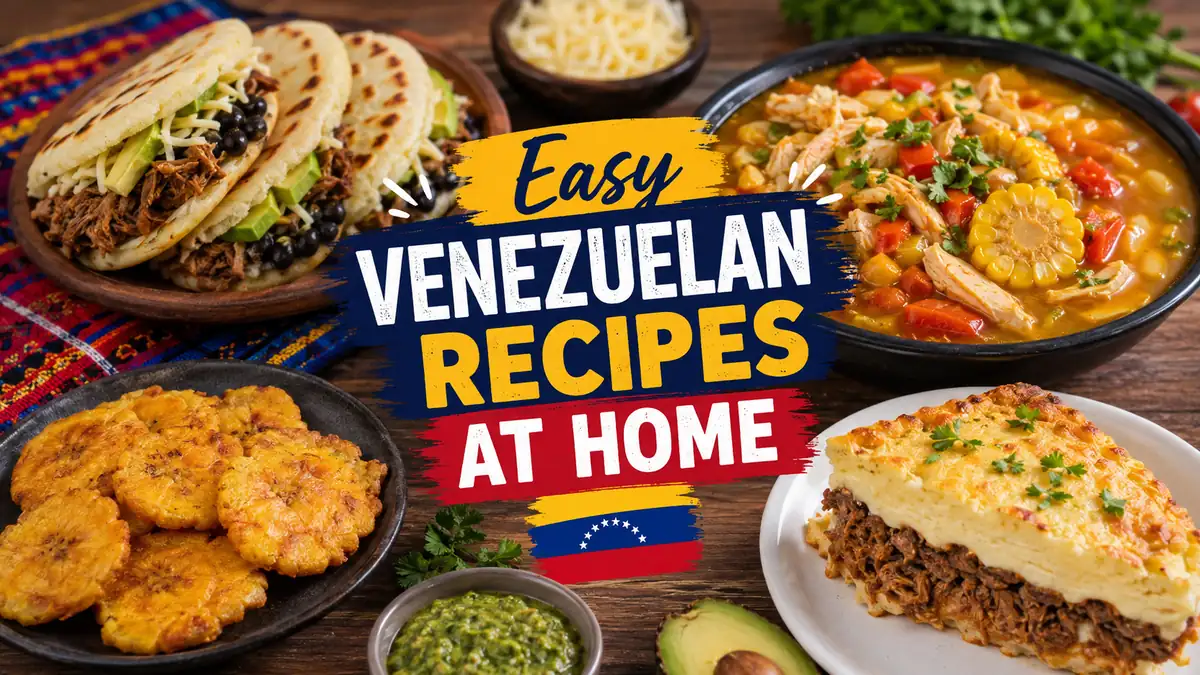

Venezuelan cooking has a useful secret: many of its most recognizable dishes begin with surprisingly ordinary ingredients. Cornmeal, beans, rice, plantains, eggs, cheese, avocado, chicken, and beef can become a table full of food that feels anything but ordinary.
If you want to try easy venezuelan recipes at home, start with everyday dishes rather than complicated holiday specialties. Arepas, cachapas, perico, black beans, sweet plantains, guasacaca, empanadas, and quesillo introduce the essential flavors and techniques of Venezuelan cuisine without requiring professional equipment or advanced cooking skills.
Quick answer: The easiest Venezuelan foods to make at home include arepas made with precooked cornmeal, perico scrambled eggs, cachapas made from sweet corn, black beans, fried plantains, guasacaca avocado sauce, and cheese-filled tequeños. Once you master those basics, dishes such as pabellón criollo and Venezuelan empanadas become much easier.
What Makes Venezuelan Food So Good for Home Cooking?
Venezuelan cuisine reflects Indigenous, European, African, and wider Caribbean and Latin American influences. That history has produced food built around corn, cassava, plantains, beans, rice, meat, fresh cheese, tropical fruits, and aromatic vegetables.
The flavors tend to be comforting rather than aggressively spicy. Onion, garlic, sweet peppers, cilantro, cumin, and sometimes paprika provide much of the savory foundation.
Corn is particularly important. Precooked cornmeal is used for arepas and Venezuelan-style empanadas, while fresh corn creates the sweeter batter used for cachapas.
You will also notice the same ingredients appearing in different combinations. Black beans might accompany rice in one meal and become an arepa filling the next morning. Shredded beef can form part of pabellón criollo at dinner and go inside an arepa later.
That makes Venezuelan food practical for home cooks.
A Beginner’s Venezuelan Pantry
You don’t need an enormous specialty-food order before you begin. A useful starter pantry includes:
| Ingredient | Common Uses | Easy Substitute |
|---|---|---|
| Precooked cornmeal | Arepas, empanadas | Look specifically for precooked arepa flour |
| Black beans | Pabellón, arepa fillings | Canned black beans |
| Plantains | Tajadas, side dishes | No exact substitute |
| White cheese | Arepas, cachapas, tequeños | Mozzarella or another mild melting cheese |
| Avocado | Reina pepiada, guasacaca | — |
| Fresh corn | Cachapas | Drained canned or thawed frozen corn |
| Rice | Pabellón, everyday meals | Any suitable long-grain white rice |
| Cilantro | Guasacaca, sauces | Parsley changes the flavor but works when necessary |
| Papelón | Drinks and sauces | Piloncillo or dark brown sugar |
One ingredient deserves special attention: precooked cornmeal is not the same thing as ordinary cornmeal or cornstarch. Arepa dough depends on flour that has already been cooked and then dried before milling. Using standard cornmeal can give you a completely different texture.
1. Arepas: The Best Place to Start
If you make only one dish from this guide, make arepas.
These round corn cakes are among Venezuela’s best-known everyday foods. They can be eaten at breakfast, lunch, or dinner and split open for almost any savory filling. Venezuelan recipe sources commonly describe combinations involving cheese, ham, beans, shredded beef, eggs, chicken, and avocado.
Easy Venezuelan Arepas
Ingredients:
- 2 cups precooked white cornmeal
- About 2½ cups warm water
- 1 teaspoon salt
- 1 tablespoon oil, optional
- Cheese, chicken, beans, eggs, or avocado for filling
How to Make Them
- Combine warm water and salt in a large bowl.
- Gradually add the precooked cornmeal while mixing with your hand.
- Let the dough rest for about 5 minutes so the flour hydrates.
- Divide it into balls and flatten each into a thick disc.
- Cook on a lightly greased skillet over medium heat until both sides develop a golden crust.
- Finish over lower heat or in the oven until the centers are cooked.
- Let them rest briefly, slice through one side, and add your filling.
The dough should feel soft and moist without sticking heavily to your fingers. If the edges crack dramatically when you shape an arepa, add a little more water.
Classic Arepa Fillings Worth Trying
Once the basic arepa is familiar, fillings turn one recipe into several meals.
Reina pepiada combines shredded chicken with avocado and usually mayonnaise. Domino pairs black beans with grated white cheese. Pelúa combines shredded beef and cheese, while perico uses Venezuelan-style scrambled eggs with tomato and onion.
For the easiest possible breakfast, fill a hot arepa with butter and cheese.
Quick Takeaway: Mastering one basic arepa dough gives you dozens of possible breakfasts, lunches, and quick dinners.
2. Perico: Venezuelan Scrambled Eggs in 15 Minutes
Some of the best easy venezuelan recipes at home aren’t elaborate recipes at all.
Perico is a good example. It’s a Venezuelan scrambled-egg preparation commonly made with tomato and onion and served for breakfast. It pairs especially well with arepas.
Ingredients
- 4 eggs
- 1 small tomato, diced
- ¼ onion, finely chopped
- 1 tablespoon butter or oil
- Salt and black pepper
- Chopped cilantro, optional
Method
Cook the onion in butter or oil until softened. Add the tomato and cook until some of its excess moisture evaporates.
Beat the eggs with a pinch of salt, pour them into the pan, and gently scramble until just set.
Don’t cook perico until it becomes dry. The tomato contributes moisture, so soft eggs work particularly well.
Serve it beside an arepa or spoon it directly inside one.
3. Cachapas: Sweet Corn Pancakes with Cheese
Arepas demonstrate the savory side of corn; cachapas show what happens when you emphasize its natural sweetness.
Cachapas are thick Venezuelan corn pancakes traditionally folded around soft white cheese. Recipes commonly combine corn with a small amount of sugar and salt, then cook the batter on a griddle or skillet. Queso de mano is traditional, while mozzarella can serve as an accessible substitute outside Venezuela.
Easy Cachapas
Ingredients:
- 3 cups corn kernels
- 2 tablespoons precooked cornmeal
- 1–2 tablespoons sugar
- ½ teaspoon salt
- 1 egg
- 2 tablespoons milk or cream, if needed
- Butter for cooking
- Sliced mozzarella or mild white cheese
Method
- Put the corn, cornmeal, sugar, salt, and egg into a blender.
- Pulse until you have a thick batter with some corn texture remaining.
- Add a splash of milk only if the mixture is too thick to spread.
- Melt a little butter in a nonstick skillet.
- Spoon in the batter and form a thick pancake.
- Cook until the underside is golden and the top begins to set.
- Flip carefully and finish the other side.
- Add cheese to one half and fold the cachapa over it.
The goal isn’t a perfectly smooth pancake batter. Leaving some texture gives cachapas their characteristic corn flavor and bite.
Why Are My Cachapas Falling Apart?
Usually the batter is too wet or the pancake was flipped too soon.
Let the first side develop a proper crust before turning it. If your corn releases lots of liquid, another spoonful of precooked cornmeal can help bind the batter.
4. Venezuelan Black Beans and Sweet Plantains
Two simple sides can make an ordinary plate feel distinctly Venezuelan: caraotas negras and tajadas.
Caraotas are black beans, often cooked with aromatics and seasonings. Tajadas are slices of ripe plantain fried until caramelized and tender.
Quick Venezuelan-Style Black Beans
For a weeknight version, use:
- 2 cans black beans, drained and rinsed
- ½ onion, chopped
- ½ bell pepper, chopped
- 2 garlic cloves, minced
- ½ teaspoon cumin
- Salt and pepper
- 1 tablespoon oil
- Water or stock as needed
Cook the onion and pepper until soft, then add garlic and cumin. Stir in the beans and enough liquid to keep everything moist.
Simmer for 15–20 minutes. Mash a small spoonful of beans against the pan if you want a thicker consistency.
Easy Fried Sweet Plantains
Choose plantains with yellow skins heavily marked with black. Green plantains contain more starch and won’t produce the same sweet, soft result.
Peel the plantain and cut it diagonally into slices. Fry the pieces in a shallow layer of oil over medium heat, turning once, until deeply golden on both sides.
Transfer them to paper towels and season lightly.
That combination of earthy black beans and sweet caramelized plantain becomes especially useful for the next dish.
5. Pabellón Criollo: Venezuela’s Classic Complete Plate
Once you can cook beans, rice, plantains, and shredded beef, you can assemble pabellón criollo, widely recognized as one of Venezuela’s defining dishes. The classic plate brings together shredded beef, black beans, white rice, and fried plantain.
It sounds like a large project, but the individual components are straightforward.
Simplified Pabellón Criollo
Prepare four elements:
- White rice – cook according to your normal method.
- Black beans – use the quick caraotas recipe above.
- Sweet plantains – fry ripe plantain slices until golden.
- Shredded beef – braise beef until tender, shred it, then simmer it with onion, pepper, garlic, and tomato.
Easy Shredded Beef
Use approximately:
- 1½ pounds beef suitable for slow cooking
- 1 onion
- 1 bell pepper
- 2 garlic cloves
- 2 tomatoes or a small amount of tomato sauce
- ½ teaspoon cumin
- Salt and pepper
- Cooking oil
Cook the beef slowly in seasoned water or stock until tender enough to pull apart.
Sauté the onion and pepper separately. Add garlic, tomato, cumin, salt, and pepper, followed by the shredded beef and a little cooking liquid. Simmer until the meat absorbs the sauce.
Then arrange the beef, beans, rice, and plantains separately on the plate.
How to Make Pabellón Easier on a Weeknight
Don’t prepare everything from scratch simultaneously.
Cook beans a day earlier, use leftover rice, and braise enough beef for two meals. Venezuelan cooking becomes dramatically easier when individual components are treated as building blocks rather than single-use recipes.
Leftover shredded beef can become an arepa filling the next day.
6. Venezuelan Empanadas for an Easy Lunch
Venezuelan empanadas differ from many wheat-flour versions because the shell can be prepared with the same general type of precooked corn flour associated with arepas.
They are shaped into half-moons around fillings and typically fried until crisp and golden. Beef is a familiar filling, but cheese, chicken, black beans, and other combinations work too. Food Network, for example, classifies its Venezuelan empanada recipe as easy, with a total preparation and cooking time of under an hour.
Simple Cornmeal Empanada Dough
Ingredients:
- 2 cups precooked cornmeal
- About 2½ cups water
- 1 teaspoon salt
- 1 teaspoon sugar, optional
- Oil for frying
Mix the water and salt, then gradually incorporate the cornmeal. Rest the dough for several minutes.
Place a ball of dough between sheets of plastic and flatten it into a circle. Put a modest spoonful of filling on one side, fold the dough over, and press the edges closed.
Fry until golden and crisp.
The Biggest Empanada Mistake
Overfilling.
A huge spoonful looks appealing until the seam opens in hot oil. Use less filling than you think you need and leave enough clean dough around the edge to form a strong seal.
7. Tequeños with Quick Guasacaca
Tequeños are Venezuelan cheese sticks wrapped in dough and fried until the outside becomes golden while the cheese softens inside. They’re closely associated with parties, family gatherings, and snacks.
Traditional versions require homemade dough, so they involve slightly more work than arepas or perico.
Basic Tequeño Ingredients
You need:
- All-purpose flour
- Butter
- Salt
- Water
- Firm white cheese
- Oil for frying
Some traditional recipes also use egg in the dough, while eggless versions are available.
Roll the dough thinly and cut it into long strips. Wrap each strip diagonally around a cheese baton, overlapping the dough slightly so no cheese is exposed.
Seal both ends firmly.
Fry the tequeños in batches until golden.
Which Cheese Works Best?
Venezuelan preparations may use firm cheeses such as queso duro or queso de freír. The important quality is that the cheese should soften without immediately disappearing into the frying oil.
A firm, low-moisture mozzarella is often the easiest supermarket alternative.
Easy Guasacaca
Guasacaca is an avocado-based green sauce frequently served with Venezuelan foods, including tequeños.
Blend:
- 1 ripe avocado
- A handful of cilantro
- ¼ small onion
- 1 garlic clove
- 1–2 tablespoons vinegar or lime juice
- 2 tablespoons olive oil
- Salt
- A little water as needed
Blend until smooth but pourable.
Taste before serving. Guasacaca needs enough acidity and salt to balance the richness of fried food.
Quick Takeaway: If you’re cooking for friends, make the guasacaca first and refrigerate it. Shape the tequeños ahead of time, then fry them shortly before serving.
8. Reina Pepiada for Leftover Chicken
Reina pepiada deserves its own place among easy venezuelan recipes at home because the filling requires very little cooking when you already have leftover chicken.
The classic combination is shredded chicken, avocado, and mayonnaise, usually served inside an arepa.
Quick Filling
Combine:
- 2 cups cooked shredded chicken
- 1 ripe avocado
- 2–3 tablespoons mayonnaise
- 1 tablespoon lime juice
- Salt and black pepper
- Finely chopped cilantro, optional
Mash part of the avocado and leave the rest slightly chunky. Fold in the chicken, mayonnaise, lime, and seasoning.
You want a creamy mixture that still has texture.
Stuff it generously into freshly cooked arepas.
Can You Make Reina Pepiada Ahead?
You can prepare the chicken ahead, but the avocado is best mixed in relatively close to serving because oxidation gradually darkens it.
Lime juice helps, as does storing the filling in an airtight container with plastic wrap pressed against the surface.
9. Papelón con Limón: A Simple Venezuelan Drink
A Venezuelan meal doesn’t have to end with food.
Papelón con limón is a refreshing drink based on unrefined cane sugar and citrus. It is particularly appealing when the meal includes fried foods such as empanadas or tequeños.
Easy Version
Dissolve about ½ cup grated papelón or piloncillo in 4 cups of water. If papelón isn’t available, dark brown sugar provides a practical, though not identical, alternative.
Once dissolved, cool the mixture and add fresh lime juice to taste.
Serve over plenty of ice.
The best ratio depends on your citrus. Start with less sweetener than you think you need and adjust after adding the lime.
10. Quesillo: An Easy Venezuelan Dessert
For dessert, try quesillo, Venezuela’s caramel custard.
It resembles flan but has its own place in Venezuelan cooking. Common preparations use eggs, condensed milk, milk, vanilla, caramelized sugar, and sometimes rum. The custard is baked in a water bath and chilled before unmolding.
Simple Quesillo
For the caramel:
- ½ cup sugar
- 2 tablespoons water
For the custard:
- 5 eggs
- 1 can sweetened condensed milk
- About the same quantity of whole milk
- 1 teaspoon vanilla
- 1 tablespoon rum, optional
Method
- Heat the sugar and water until you have an amber caramel.
- Carefully coat the bottom of your baking mold.
- Blend the eggs, condensed milk, whole milk, vanilla, and optional rum.
- Pour the custard over the caramel.
- Place the mold inside a larger roasting pan.
- Pour hot water around it to create a bain-marie, or water bath.
- Bake until the center is set but still has a slight wobble.
- Cool, then refrigerate for at least several hours.
- Run a knife around the edge and invert onto a plate.
A typical quesillo needs roughly 50–60 minutes in a 180°C/350°F oven, although pan dimensions and ovens vary.
Don’t rush the chilling stage. A warm custard is much more likely to break when unmolded.
Which Venezuelan Recipes Should a Beginner Make First?
Trying to cook ten unfamiliar dishes in one weekend is unnecessary.
A much better progression is:
- Perico – teaches the flavor combination of tomato and onion with almost no technical difficulty.
- Arepas – introduces precooked cornmeal and becomes the foundation for many meals.
- Guasacaca – requires little more than blending.
- Sweet plantains – teaches you how ripeness changes plantain texture and flavor.
- Black beans – inexpensive, forgiving, and useful in several dishes.
- Cachapas – introduces another Venezuelan approach to corn.
- Reina pepiada – combines your arepa skills with an easy filling.
- Empanadas – builds on your experience handling corn dough.
- Tequeños – introduces homemade wheat dough and frying.
- Pabellón criollo – brings several Venezuelan staples together on one plate.
Quesillo can fit anywhere in that progression because most of its work is hands-off baking and chilling.
How to Find Venezuelan Ingredients Outside Venezuela
One common obstacle isn’t technique; it’s ingredient names.
Large supermarkets may not stock everything under the terminology used in a Venezuelan recipe. Latin American and Caribbean grocery stores are usually better places to look for precooked corn flour, queso de freír, papelón, and suitable plantains.
For arepas, packages labeled precooked white cornmeal or arepa flour are what you want. Don’t substitute masa harina without expecting the flavor and texture to change.
For cachapas, traditional queso de mano can be difficult to find. A mild, soft melting cheese is a practical alternative; mozzarella is specifically suggested as an option in some modern recipes.
For tequeños, prioritize the cheese’s behavior rather than its exact name. It should be firm enough to cut into batons and capable of surviving frying inside the dough.
Are Venezuelan Recipes Usually Spicy?
Not necessarily.
Someone approaching Venezuelan food through a general “Latin food” label may assume that hot chilies dominate the cuisine. That’s not a reliable expectation.
Many classic dishes emphasize savory aromatics, corn, cheese, meat, beans, avocado, plantains, and contrasting sweet-salty flavors rather than intense chile heat.
Hot sauce can certainly accompany the meal, but you don’t need to make every dish fiery for it to taste Venezuelan.
Building a Complete Venezuelan Meal at Home
If you’re cooking Venezuelan food for the first time, build your menu around one substantial dish rather than trying to reproduce an enormous feast.
For a quick breakfast, make arepas filled with perico and cheese.
For an easy lunch, serve reina pepiada arepas with guasacaca.
For a snack night, prepare tequeños, empanadas, guasacaca, and papelón con limón.
For a family dinner, make pabellón criollo with shredded beef, caraotas negras, white rice, and sweet plantain.
For dessert, chill quesillo ahead of time so nothing needs your attention once dinner starts.
Venezuelan cuisine also contains more time-intensive specialties worth exploring once you’re comfortable with the basics. Hallacas—corn dough parcels traditionally associated with Christmas—require considerably more preparation, while pan de jamón is another holiday favorite made with bread dough, ham, olives, and raisins. Pasticho, asado negro, casabe, patacón maracucho, chicha, and sancocho offer further routes into the country’s regional and family cooking traditions.
They don’t all need to be your first project.
Practical Tips That Make Venezuelan Home Cooking Easier
The biggest improvement comes from learning ingredients rather than memorizing recipes.
Hydrate corn dough properly. Give precooked cornmeal several minutes to absorb water before deciding that your dough is too wet or dry.
Use properly ripe plantains. For sweet tajadas, yellow plantains with extensive black markings are usually preferable to firm green ones.
Season components individually. Pabellón contains several foods on one plate. Bland beans won’t magically become flavorful because the beef is well seasoned.
Don’t overcrowd frying oil. Adding too many empanadas or tequeños at once lowers the oil temperature and encourages greasy results.
Make sauces ahead. Guasacaca stores well enough to remove one task from last-minute meal preparation; one Food Network preparation notes refrigerated storage in an airtight container for up to five days.
Cook once, reuse twice. Extra black beans become Domino arepas. Leftover shredded beef becomes Pelúa. Cooked chicken becomes reina pepiada.
That last habit is especially useful. Venezuelan home cooking becomes easier when you see the cuisine as a collection of compatible components.
Start with the Simplest Venezuelan Classics
You don’t need an elaborate pantry or years of Latin American cooking experience to make easy venezuelan recipes at home.
Start with precooked cornmeal, eggs, cheese, beans, ripe plantains, avocado, chicken, and a few fresh aromatics. Make arepas first. Add perico for breakfast, reina pepiada for lunch, or black beans and cheese when you want something meatless.
Once you’re comfortable with those building blocks, move on to cachapas, empanadas, and tequeños. Then prepare a full pabellón criollo and finish with chilled quesillo.
That’s a far easier way to learn Venezuelan cooking than attempting the most complicated traditional dishes first—and it gives you several recipes you’ll actually want to make again.
