
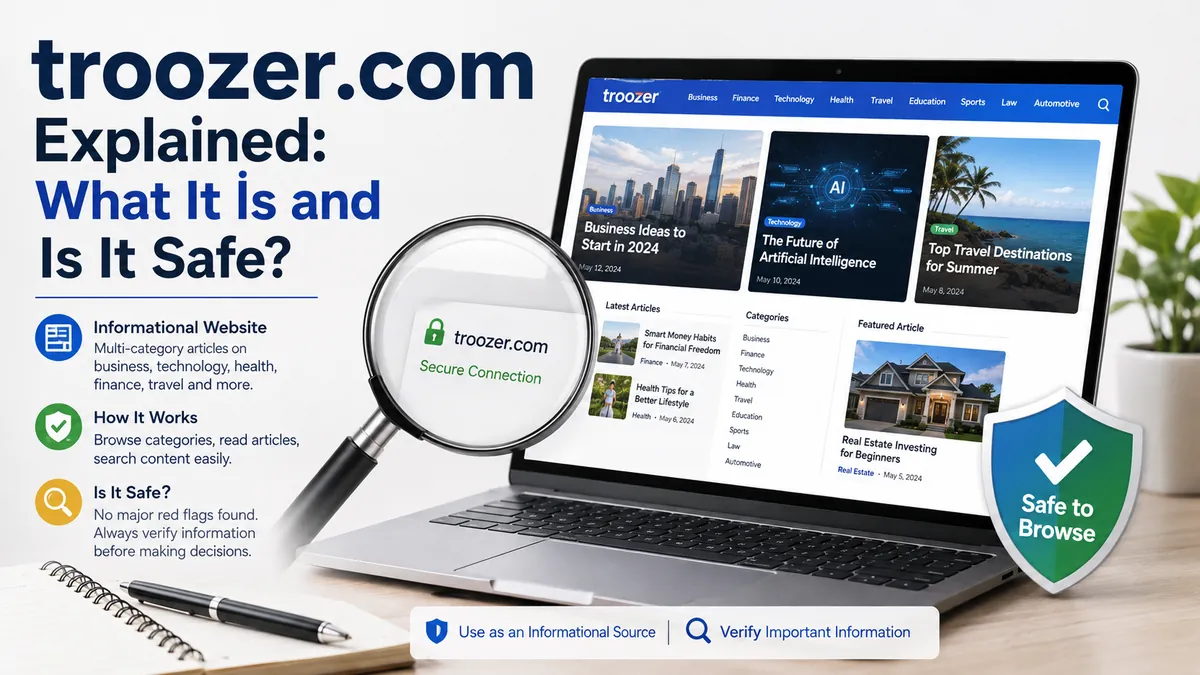

Search for troozer.com and you will quickly run into a strange problem: different websites describe it as completely different things. Some call it an AI productivity platform, others describe an online marketplace, and several recent reviews identify it as a general digital publishing website.
The strongest available evidence supports the last explanation.
troozer.com currently appears to function primarily as a multi-category online publication where visitors read articles covering subjects such as business, finance, technology, health, travel, education, sports, law, automotive topics, and real estate. Claims that it operates as project-management software, an e-commerce marketplace, cloud-storage service, or AI workspace are not clearly supported by the visible website structure.
That distinction matters because much of the confusion surrounding the domain comes from third-party descriptions rather than clearly demonstrated features.
What Is troozer.com?
troozer.com is best understood as a broad digital media and informational content website rather than a conventional software application.
Recent examinations of the site describe a familiar publishing structure: category pages, article listings, publication dates, authors, search functionality, recent posts, archives, and individual articles. Those elements resemble an online magazine or general-interest blog much more closely than a SaaS dashboard or online store.
Older indexed content provides further context. Search results contain a Troozer article published in October 2020 about using vacant land to build a business. The page follows a standard editorial format with a headline, article body, author information, and category classification.
Current descriptions of the website commonly associate it with subjects including:
- Business and entrepreneurship
- Finance
- Technology and artificial intelligence
- Education
- Health
- Travel
- Automotive topics
- Law
- Sports
- Real estate
- Lifestyle-related information
A public Linktree profile associated with Troozer similarly describes the website as providing content across technology, AI, finance, crypto, business, education, health, and lifestyle categories.
The simplest explanation, therefore, is that Troozer is a general publishing platform covering multiple industries rather than one specialized subject.
Why Is There So Much Confusion About troozer.com?
The unusual part of researching troozer.com is not what the visible website does. It is how dramatically outside descriptions differ.
Some third-party articles have characterized Troozer as an all-in-one productivity system. These descriptions mention project boards, collaboration tools, automation, file storage, task management, online shopping, price comparison, e-commerce functions, and even AI-powered workflows.
Other sources describe something much simpler: a content website containing articles.
Recent investigations have highlighted this contradiction directly, noting that claims involving project management, shopping, cloud collaboration, or software dashboards frequently lack visible evidence on the live publication itself.
That means readers need to separate two questions:
| Question | Evidence-based answer |
|---|---|
| Does Troozer publish online articles? | Yes, indexed Troozer pages clearly demonstrate editorial content. |
| Is it a productivity application? | Not clearly demonstrated by current public evidence. |
| Is it an online marketplace? | No convincing visible evidence supports this description. |
| Does it provide project-management dashboards? | Claims exist, but verifiable documentation is limited. |
| Is it a general information website? | This interpretation is strongly supported by its indexed content and recent site reviews. |
A common SEO problem can make situations like this worse. Once several websites repeat an unverified description of an obscure domain, later articles may copy or paraphrase the same description. Search results can then make a claim appear established even though the underlying evidence remains weak.
That is why directly observable website behavior matters more than the number of blogs repeating a feature list.
How troozer.com Actually Works
For an ordinary visitor, using troozer.com appears similar to using most online magazines.
You discover the website through a search engine or visit it directly, browse a topic, choose an article, and read the information in your browser. Recent site examinations report navigation across multiple categories along with article archives and normal website-search functionality.
There is an important difference between a site’s search feature and being a search engine.
A publication may have a search box that helps readers locate its own articles. That does not make it a private search engine or a competitor to Google, Bing, or DuckDuckGo.
The same logic applies to other supposed Troozer features. An article about productivity software does not mean Troozer itself provides productivity software. An article discussing e-commerce does not make the website an e-commerce platform.
This sounds obvious, but it explains a considerable amount of the contradictory information surrounding the domain.
Does troozer.com require an account?
Recent reviews examining the live publication report that ordinary article reading does not appear to require mandatory account registration. One review also reports no visible purchasing or payment process associated with normal content consumption.
That makes the typical interaction closer to visiting a blog than signing into a cloud application.
What Type of Content Can You Find on troozer.com?
Because Troozer uses a multi-category publishing model, its subject coverage can be broad.
An indexed 2020 article, for example, discusses business opportunities involving vacant land, including land flipping, bed-and-breakfast properties, glamping, renewable-energy leasing, farming, events, and owner financing.
More recent reviews report categories and articles touching technology, business, finance, health, travel, law, sports, automotive topics, AI, online services, and other general-interest areas.
This breadth helps explain why someone arriving through Google may have difficulty immediately identifying Troozer’s niche.
It is not necessarily designed around one tightly defined audience. Someone could encounter the domain while researching technology and another reader could arrive through a business, health, or travel query.
Is a broad topic range a problem?
Not automatically.
Many established publishers cover several unrelated categories. The more relevant question is whether each individual article provides accurate, well-sourced, current information.
This becomes especially important when content touches areas such as health, finance, investing, law, cybersecurity, or other topics where incorrect information can have significant consequences.
Is troozer.com Safe to Visit?
There are two separate meanings of “safe” that readers should understand.
The first is technical website safety: whether simply loading a website appears to expose visitors to malware, deceptive downloads, credential theft, or similar threats.
The second is information reliability: whether the claims made in an article are sufficiently accurate to trust.
These are not the same thing.
Recent reviews generally describe Troozer as a publicly accessible content site rather than a transactional platform requiring payment details for ordinary reading. That reduces some of the risks associated with unknown e-commerce websites, although it does not prove that every page or external link should automatically be trusted.
There is also limited independent reputation data compared with major established publishers. Several reviewers have specifically pointed to inconsistent third-party descriptions and relatively limited publicly verified information about the organization behind the site.
A reasonable approach is therefore neither “Troozer is definitely dangerous” nor “everything on Troozer can automatically be trusted.”
Treat it the same way you should treat any unfamiliar informational website: examine the particular page and the evidence behind its claims.
How to Evaluate Information You Find on troozer.com
When an article gives general explanations or ideas, verifying every sentence may be unnecessary. But when a claim could influence your health, finances, legal position, security, or major purchase, verification becomes essential.
Start with the publication date. Older information may still be useful for evergreen subjects, but technology, financial rules, visa requirements, regulations, medical guidance, product specifications, and software features can become outdated quickly.
Next, examine the author. Look for an identifiable writer, relevant experience, editorial information, and evidence that the person understands the subject.
Then check the sources. Strong factual articles normally allow important claims to be traced back to primary or authoritative information.
For example, depending on the topic, better verification sources may include government agencies, universities, recognized medical organizations, regulators, company documentation, standards bodies, court or legislative sources, and original research.
Finally, distinguish editorial content from external destinations. Even when a publication itself is harmless to browse, an outbound link takes you to another website with its own security practices, privacy policy, and business model.
A practical trust test
Before relying heavily on a Troozer article—or information from any unfamiliar publication—ask four questions:
- Who wrote this? Is the author clearly identified?
- When was it published or updated? Is the information still current?
- Where did the important facts come from? Are credible sources available?
- Can the central claim be independently confirmed? Check authoritative sources when the stakes are high.
This method is more reliable than judging a website solely from its design or domain name.
Is troozer.com a Productivity or AI Platform?
This is one of the biggest misconceptions surrounding the keyword.
Search results contain articles claiming that Troozer offers productivity dashboards, task management, collaboration, cloud storage, automation, artificial intelligence, online shopping, or e-commerce tools. Some even compare the supposed product with established platforms such as Trello, Asana, Shopify, and Monday.com.
However, these descriptions should not be treated as verified Troozer features simply because multiple articles repeat them.
More recent investigations that compare those claims with the site’s visible structure describe Troozer as an editorial publication and report no corresponding project boards, checkout system, seller dashboard, collaboration workspace, or similar software interface.
That creates an important research lesson: repetition across search results is not the same as independent verification.
Until a feature can be demonstrated through official documentation or the actual product interface, claims about sophisticated Troozer software functionality should be treated cautiously.
Is troozer.com Legit?
“Legit” can mean several different things.
If the question is whether Troozer exists as a functioning website that has published real web pages, the answer is clearly yes. Search engines have indexed Troozer content going back years, including material from October 2020.
If “legit” means whether every online description of Troozer is accurate, the answer is no. Different third-party sources make incompatible claims about what the domain represents.
And if “legit” means whether every piece of information published there should be accepted without independent verification, that standard would be unreasonable for Troozer or almost any other general-interest publication.
Readers should judge credibility at both the website and article level.
The most significant issue surrounding Troozer is therefore not evidence of a specific scam. It is information ambiguity: there is substantial disagreement across search results about what the site actually offers.
Why troozer.com Appears in Search Results
Troozer has published content across numerous topics, so readers may encounter the domain while searching queries unrelated to the brand itself.
At the same time, curiosity around the website has created a second search ecosystem consisting of queries such as “what is Troozer,” “Troozer review,” “is Troozer safe,” and “is Troozer legit.”
Recent articles increasingly focus on correcting or investigating the conflicting descriptions appearing in earlier reviews.
That cycle can amplify the brand name even further: uncertainty produces searches, searches encourage publishers to write explanatory articles, and those articles produce more differing descriptions.
For readers, the solution is straightforward. Focus on evidence about the actual website rather than treating every search result as equally authoritative.
What Readers Should Remember About troozer.com
Based on the strongest currently available evidence, troozer.com is primarily a multi-category informational publishing website.
Its indexed pages and reported website structure support an online-magazine model containing articles, authors, dates, categories, archives, and search functionality. Older Troozer content dating to 2020 also demonstrates that editorial publishing has been part of the domain’s history.
Descriptions portraying it as a project-management suite, online marketplace, AI workspace, cloud collaboration service, shopping aggregator, or e-commerce platform should be treated as unverified unless those services can be independently demonstrated.
For ordinary readers, the sensible next step is simple: use troozer.com as an informational source rather than assuming it provides the software features attributed to it elsewhere, and independently verify any high-stakes health, financial, legal, security, or similarly consequential information before acting on it.
