
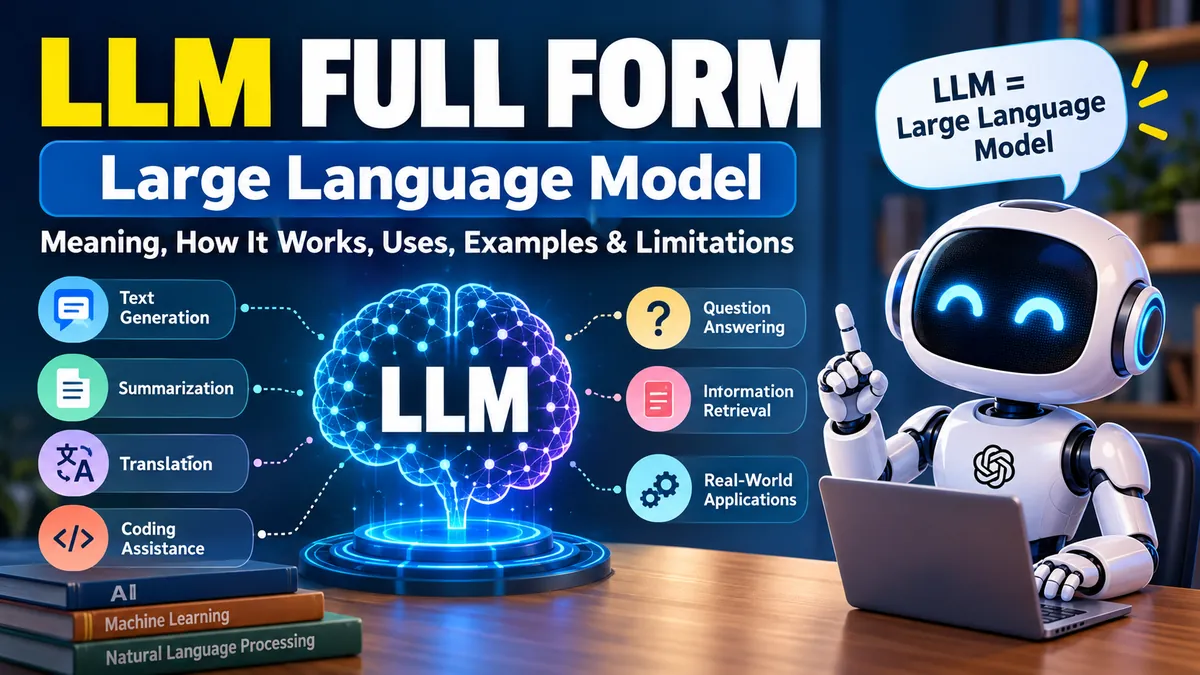

If you have used an AI chatbot, asked a tool to summarize a document, or generated code from a simple prompt, there is a good chance a large language model was working behind the scenes.
The llm full form is Large Language Model in artificial intelligence. An LLM is an AI model trained on enormous amounts of data to recognize patterns in language and generate useful responses. Modern LLMs can answer questions, summarize documents, translate languages, generate code, classify text, and perform many other natural language processing tasks. IBM
The term sounds complicated, but the basic idea is surprisingly approachable. An LLM learns statistical relationships between pieces of information and uses those patterns to predict what should come next when responding to a prompt.
What Is the llm full form?
In AI and machine learning, LLM stands for Large Language Model.
The three words describe what the technology does:
| Term | Meaning |
|---|---|
| Large | The model is trained using enormous datasets and generally contains many learned parameters. |
| Language | It processes language and, depending on the model, may also work with code and other data types. |
| Model | It is a trained computational system that learns patterns and uses them to produce predictions or outputs. |
A useful way to think about an LLM is as an extremely sophisticated prediction system.
When you enter a prompt, the model processes that input and predicts appropriate subsequent tokens. This prediction process continues until it has generated a response. Doruva
That seemingly simple mechanism can produce surprisingly complex behavior.
What Is a Large Language Model?
A large language model is a type of artificial intelligence model designed to process and generate language and other structured sequences.
LLMs belong to the broader fields of machine learning, deep learning, natural language processing (NLP), and generative AI.
Google Cloud describes an LLM as a statistical language model trained on massive amounts of data that can generate and translate content and perform NLP tasks. IBM similarly describes LLMs as deep-learning models trained on immense datasets. Google Cloud
Modern models can perform tasks such as:
- answering questions
- generating and rewriting text
- summarizing documents
- translating languages
- extracting information
- writing and explaining computer code
- classifying text
- supporting conversational AI
- analyzing supplied information
- following natural-language instructions
Some modern AI models are also multimodal, meaning they can work with combinations of text, images, audio, video, or other forms of information rather than text alone. Google Cloud
Is an LLM the Same as AI?
No.
Artificial intelligence (AI) is the broad field of creating computer systems capable of tasks associated with intelligence.
An LLM is one particular type of AI model.
A simple hierarchy looks like this:
Artificial Intelligence → Machine Learning → Deep Learning → Large Language Models
Generative AI overlaps this hierarchy because LLMs are widely used to generate new content.
So every LLM is part of AI, but not every AI system is an LLM.
A computer-vision system that identifies objects in photographs, for example, can be an AI system without being a traditional language model.
How Does an LLM Work?
An LLM does not store a giant collection of prepared answers and select one whenever somebody asks a question.
Instead, training teaches the model statistical patterns and relationships in data.
When the trained model receives a prompt, it uses those learned relationships to calculate likely continuations.
The process can be simplified into five stages.
1. Large Amounts of Training Data Are Processed
Training starts with large datasets that can contain text, code, documents, books, articles, websites, or other appropriate data, depending on how the particular model was developed.
The model examines patterns throughout that information.
It is not simply memorizing a dictionary. It learns relationships among words, phrases, concepts, structures, and contexts.
2. Text Is Divided Into Tokens
LLMs generally process tokens rather than treating every sentence as one object.
A token can represent a whole word, part of a word, punctuation, or another small unit of text.
For example, a sentence is converted into a sequence of tokens that the model can mathematically process.
Tokenization also matters because LLMs have limits on how much information they can process within a particular interaction. This is commonly described through the model’s context window. Doruva
3. Tokens Become Numerical Representations
Computers cannot directly understand words the way people do.
Tokens therefore need mathematical representations.
One important concept here is an embedding. Embeddings represent information numerically so relationships can be processed by the neural network.
Words or concepts that appear in similar contexts can develop representations that capture useful relationships.
4. Transformers Analyze Context
Most widely used modern LLMs rely heavily on the Transformer architecture.
The Transformer was introduced in the influential 2017 research paper Attention Is All You Need by Ashish Vaswani and colleagues. The architecture uses attention mechanisms rather than relying on the recurrent structures that were common in earlier sequence models. Google Research
A key idea is self-attention.
Self-attention helps the model evaluate relationships among different parts of a sequence.
Consider:
Sarah put the laptop in her bag because she needed it at work.
Understanding what “it” refers to requires considering earlier words and their relationships.
Attention mechanisms help models capture this type of context.
5. The Model Predicts the Next Token
Once an LLM receives your prompt, it calculates probabilities for possible next tokens.
A token is selected according to the model’s generation process. The new token becomes part of the sequence, and another prediction follows.
Conceptually:
Prompt → Tokens → Model processing → Next-token probabilities → Generated token → Repeat
This continues until the response is finished.
That is why an LLM is sometimes described as an extraordinarily advanced form of autocomplete. The comparison is useful for understanding the basic mechanism, although modern LLM capabilities extend far beyond ordinary autocomplete.
Why Are They Called “Large” Language Models?
There is no universal parameter threshold at which a language model suddenly becomes “large.”
The word large generally reflects scale across several dimensions.
Large Training Datasets
Modern models can learn from enormous collections of data.
More diverse training material can expose a model to many linguistic patterns, topics, writing styles, and relationships.
Large Numbers of Parameters
A parameter is a learned numerical value within a neural network.
During training, these values are adjusted so that the model becomes better at its objective.
LLMs can contain billions or more parameters, although parameter count alone does not determine model quality.
Architecture, training data, data quality, training techniques, post-training, inference strategies, and available computing resources all matter.
Research and industry work on scaling laws has examined relationships among model performance, data, parameters, training compute, and inference-time compute. NVIDIA Blog
Large Computing Requirements
Training advanced models can require substantial computational resources.
Specialized accelerators such as GPUs are widely used because neural-network workloads involve huge numbers of mathematical operations that can benefit from parallel processing.
This is one reason companies such as NVIDIA and major cloud providers play an important role in AI infrastructure.
Training vs. Using an LLM
One common source of confusion is the difference between training and inference.
They are not the same process.
| Training | Inference |
|---|---|
| Teaches the model patterns | Uses the trained model |
| Requires training datasets | Starts with a user or application input |
| Adjusts model parameters | Usually does not retrain core parameters |
| Computationally intensive | Generates predictions or responses |
| Happens before deployment or during later training cycles | Happens when the model is used |
When you type a question into an AI application and receive an answer, you are generally interacting with a model during inference.
Pretraining, Fine-Tuning, and Post-Training
Developing a useful LLM involves more than feeding it text once.
Pretraining
During pretraining, a model learns broad statistical patterns from large datasets.
This creates a general-purpose base or foundation model that can potentially support many tasks.
Fine-Tuning
A pretrained model can then be fine-tuned using more targeted data.
Fine-tuning can help adapt a model for a particular task, domain, behavior, or application.
Instruction Tuning and Alignment
Models can undergo additional post-training so they respond more effectively to human instructions.
Human feedback and other preference-optimization methods may also be used to improve helpfulness, safety, and instruction following.
The exact development pipeline varies considerably among models.
Common Examples of LLMs
Several model families have made large language models familiar outside AI research.
Well-known examples include models from organizations such as:
- OpenAI
- Google DeepMind
- Anthropic
- Meta
- Microsoft and its AI partners
- Mistral AI
- Cohere
Examples of model families commonly associated with modern generative AI include GPT, Gemini, Claude, and Llama.
Google, for example, describes Gemini as a multimodal model capable of combining different kinds of information, while Meta’s Llama family has included models designed for tasks such as language understanding, generation, coding, math, and tool use. Google Cloud
Is ChatGPT an LLM?
The distinction is worth understanding.
ChatGPT is an AI application/assistant that uses underlying models. An LLM is the model technology that can power such an application.
Think of it as:
LLM = underlying model
AI assistant = product/interface that lets people interact with one or more models and associated tools
The terms are often used casually as if they mean the same thing, but technically they describe different layers of the system.
What Are LLMs Used For?
The flexibility of large language models is one reason they have spread across so many industries.
Text Generation
An LLM can produce:
- explanations
- reports
- emails
- outlines
- descriptions
- drafts
- structured responses
The quality still depends heavily on the model, instructions, context, and verification process.
Question Answering
Conversational systems can respond to questions written in ordinary language.
When connected to external information sources, databases, search systems, or tools, LLM applications can also retrieve information before constructing an answer.
Summarization
LLMs can condense long material such as:
- reports
- meeting notes
- articles
- research documents
- customer conversations
This is especially useful when the original material is supplied directly to the system.
Translation
Language models can translate and rewrite content across languages.
Translation quality varies by model, language pair, context, and specialized terminology, so important translations may still require human review.
Coding
Models trained on programming-related data can help:
- generate code
- explain functions
- identify possible bugs
- convert between programming languages
- write documentation
- create tests
The generated code should still be tested rather than assumed to be correct.
Search and Information Retrieval
Traditional search systems primarily retrieve documents or results.
LLM-based systems can add a conversational layer that interprets questions, synthesizes supplied information, and generates natural-language responses.
A particularly important approach is retrieval-augmented generation (RAG).
In a RAG system, relevant information is retrieved from an external source and supplied to the model as context before it generates an answer.
This can help applications work with company documents, knowledge bases, current information, or specialized datasets rather than depending entirely on knowledge represented in model parameters.
LLMs vs. Traditional Search Engines
An LLM and a search engine solve related but different problems.
| Large Language Model | Traditional Search Engine |
|---|---|
| Generates responses | Retrieves and ranks information |
| Interprets natural-language prompts | Finds relevant documents/pages |
| Can summarize supplied context | Directs users toward sources |
| Can generate new text | Primarily indexes existing information |
| May produce unsupported statements | Allows users to inspect original sources |
Modern products increasingly combine both approaches.
Search can retrieve current evidence, while an LLM can help interpret or summarize it.
For factual research, this combination can be safer than treating generated text alone as an authoritative source.
What Are the Benefits of Large Language Models?
LLMs have become popular because one general model can support many tasks.
Natural-Language Interaction
People do not always need to learn complicated commands.
They can simply describe what they want.
For example:
Summarize this report in five bullet points for a nontechnical audience.
That instruction combines summarization, formatting, and audience adaptation in ordinary language.
Flexibility
The same underlying model may be able to translate text, answer questions, classify documents, generate code, or rewrite content.
Google Cloud highlights this flexibility as one of the major benefits of pretrained LLMs. Google Cloud
Productivity
LLMs can accelerate repetitive language-based work such as drafting, summarizing, categorizing, extracting, and restructuring information.
The strongest workflows usually treat AI output as a starting point or assistant rather than automatically trusting everything it generates.
Adaptability
Organizations can adapt models through prompting, fine-tuning, retrieval systems, tools, APIs, and application-specific instructions.
This allows one underlying technology to support many specialized workflows.
What Are the Limitations of LLMs?
Understanding llm full form is useful, but understanding what these models cannot reliably do is even more important.
An articulate response is not necessarily a correct response.
Hallucinations
An LLM can generate information that sounds plausible but is false or unsupported.
These errors are commonly called hallucinations.
A 2026 Nature paper describes hallucinations as confident, plausible falsehoods and examines why model evaluation can encourage confident guessing rather than abstention. Nature
That means LLM-generated facts should be verified when accuracy matters.
Knowledge Can Be Incomplete or Outdated
A model’s built-in knowledge depends partly on its training and subsequent updates.
It does not automatically know every event happening right now.
Applications may therefore use live web search, retrieval systems, databases, APIs, or other tools to obtain newer information.
Context Windows Are Finite
An LLM can only process a limited amount of context in a given interaction.
That limit is called the context window.
Modern systems can support very large context windows, but a larger window does not guarantee that every detail will be remembered or weighted equally well.
Research has documented difficulties in effectively using information positioned within long contexts. DOI
Bias Can Appear in Outputs
Models learn patterns from their training data and post-training processes.
Biases present in data, labeling, feedback, or system design can influence model behavior.
Responsible deployment therefore requires evaluation, safeguards, and monitoring.
LLMs Do Not Guarantee Truth
Next-token prediction is fundamentally different from consulting a verified factual database.
An LLM generates an answer based on learned patterns and available context.
For medicine, law, finance, security, academic research, and other high-stakes situations, important claims should be checked against authoritative sources.
What Is the Difference Between an LLM and a Small Language Model?
Not every useful language model needs to be enormous.
Small language models (SLMs) generally use fewer computational resources and may be optimized for narrower applications.
| LLM | SLM |
|---|---|
| Generally larger | Generally smaller |
| Broad capabilities | Can focus on narrower tasks |
| Higher infrastructure demands | Often lower computing requirements |
| Strong general-purpose potential | Can be efficient for specialized deployment |
| Common in cloud AI services | Can suit edge or resource-constrained environments |
A larger model is not automatically the right model for every task.
For a narrow, repetitive application, a smaller specialized model may provide sufficient performance with lower latency and computing costs.
What Does Prompt Mean in an LLM?
A prompt is the input or instruction given to the model.
For example:
Explain photosynthesis to a 12-year-old in 100 words.
This prompt provides a task, target audience, and length constraint.
Clear prompts usually provide better context for the model.
Useful prompts often specify:
- what the model should do,
- relevant background information,
- constraints,
- desired output format, and
- examples when the task is complicated.
This practice is commonly called prompt engineering.
It does not change the fundamental model every time you submit a prompt. Instead, it provides context that guides inference.
LLM, NLP, Generative AI, and Foundation Models
AI terminology overlaps, which can make these concepts confusing.
NLP
Natural Language Processing (NLP) is the field concerned with computers processing and working with human language.
LLMs are one technology used for NLP tasks.
Generative AI
Generative AI refers to AI systems that generate new content.
That content may include text, images, audio, video, code, or other outputs.
LLMs are an important part of generative AI, particularly for language and code.
Foundation Model
A foundation model is broadly trained and can be adapted to multiple downstream tasks.
Many LLMs are foundation models.
However, foundation models can also be designed for modalities beyond text.
Transformer
A Transformer is a neural-network architecture.
An LLM is a trained model, while the Transformer is the architectural foundation used by many modern LLMs.
The concepts are related, but they are not synonyms.
Does LLM Have Another Full Form?
Yes, and context matters.
In legal education, LL.M. commonly refers to Master of Laws, derived from the Latin Legum Magister. It is an advanced postgraduate law degree. Careers360
Therefore:
| Context | LLM Meaning |
|---|---|
| Artificial intelligence | Large Language Model |
| Law/education | Master of Laws (LL.M.) |
If someone discusses ChatGPT, Gemini, AI, machine learning, NLP, transformers, prompts, or generative AI, LLM almost certainly means Large Language Model.
If the discussion concerns universities, law degrees, LLB graduates, legal specialization, or postgraduate education, it likely means Master of Laws.
Why Are LLMs Important?
For decades, using computers usually required humans to communicate in ways machines expected.
People learned commands, programming languages, menus, query syntax, and specialized interfaces.
LLMs change part of that relationship.
Now a person can describe a task in everyday language:
Compare these two contracts.
Explain this code.
Summarize this report.
Translate this paragraph.
Extract the dates from these notes.
The model acts as a language interface between the person and a computational system.
This does not make traditional software obsolete. Instead, LLMs can become another layer through which users interact with software, data, search systems, databases, and external tools.
The Key Things to Remember About llm full form
The llm full form is Large Language Model when the term is used in artificial intelligence.
An LLM is a deep-learning model trained on large amounts of data to learn patterns and generate outputs. Most modern LLMs are based on Transformer architectures and work by processing tokens and repeatedly predicting likely next tokens. They can support question answering, summarization, translation, coding, content generation, and many other NLP tasks. IBM
The technology is powerful, but it is not infallible. LLMs can hallucinate, miss context, reflect biases, or provide outdated and incorrect information. Their outputs should therefore be verified whenever factual accuracy matters.
And remember the context distinction: in AI, LLM means Large Language Model; in legal education, LL.M. means Master of Laws.
